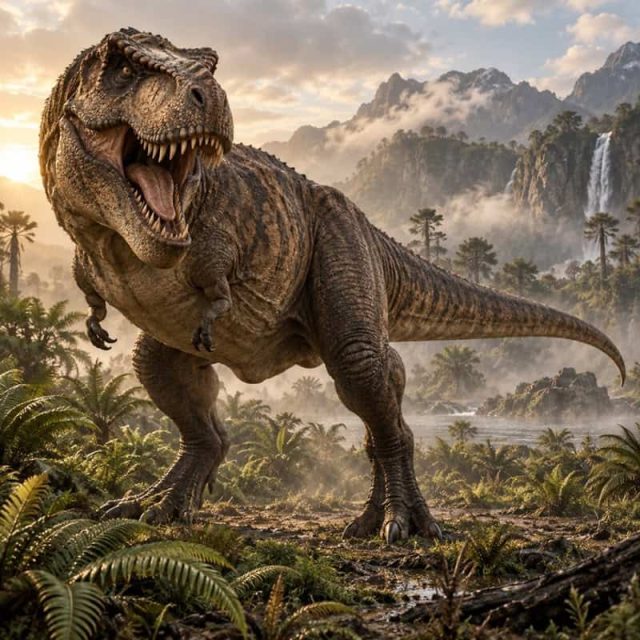
16-Tyrannotitan

Tyrannotitan

familia

Family

Theropods

tiempo

Era

Mid-Cretaceous, 118 to 112 million years ago

Where he lived?

Argentina

dieta
https://dinosaurland.es/wp-content/uploads/2022/09/ccarnivoros.svg
peso

Weight

7.000Kg

altura

Height

4,3m

largo

Length

13m

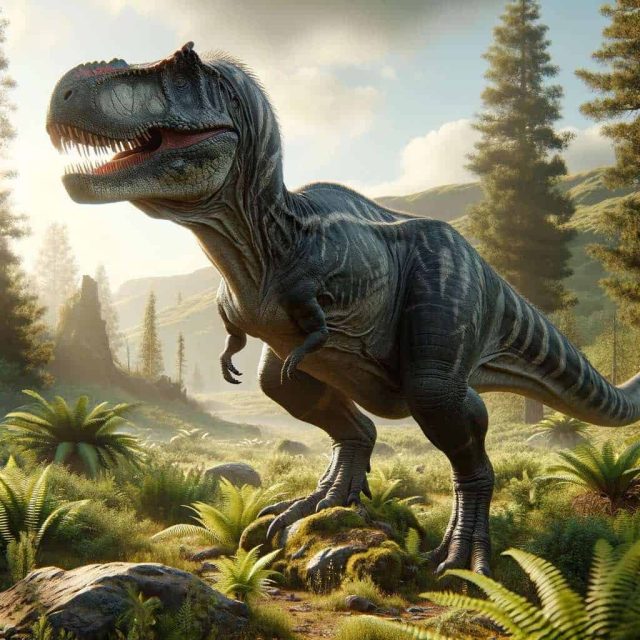
It had anatomical features that allowed it to hunt large animals. Although it had very short arms, this did not prevent it from being an efficient predator. Its vertebrae lacked the pneumatic sacs found in other carcharodontosaurids, giving it a more robust and dense vertebral structure.

The proximal caudal vertebrae of Tyrannotitan had an exceptionally high neural spine, approximately twice the size of the vertebral centrum. This feature gave it a deep and powerful tail, useful for both balance and defense.

Discovery and Research

The fossils of Tyrannotitan chubutensis, the only known species of this genus, were found in the province of Chubut, Argentina. They were discovered by technicians Pablo Puerta and Leandro Guerrero and described by Fernando Novas and his team in 2005. The remains were found in the Cerro Barcino geological formation and date back to the Aptian, approximately 121 to 113 million years ago.

The holotype includes parts of the jaws, teeth, dorsal vertebrae, ribs, and several other bones, allowing a detailed reconstruction of this dinosaur. A reconstructed skeleton of Tyrannotitan is currently on display at the Egidio Feruglio Paleontological Museum in Argentina.

Classification and Evolutionary Relationships

Tyrannotitan belongs to the family Carcharodontosauridae, and is in a basal position within this group, indicating that it is one of the more primitive members. It is closely related to other large predators such as Giganotosaurus, Mapusaurus, and Carcharodontosaurus. These dinosaurs are part of the Giganotosauria clade, characterized by having very large and powerful skulls.
Function of the Short Arms

Although Tyrannotitan had short arms, this feature is believed not to have hindered its predatory abilities. Like other carcharodontosaurids, it relied on its large size, powerful jaws, and sharp teeth to capture and dismember its prey. The short arms likely evolved due to the reduced need to manipulate objects or prey with the forelimbs.

Habitat and Behavior

Tyrannotitan lived in what is now Patagonia, a region that during the Early Cretaceous was covered with forests and open plains, providing an ideal habitat for large predators. Its robust structure and ability to hunt large prey suggest that it was an active and dominant hunter in its ecosystem.

Tyrannotitan Trivia

One of the most fascinating features of Tyrannotitan is the difference in its vertebral structure compared to other carcharodontosaurids. The absence of pneumatic sacs and the presence of high neural spines gave it a unique skeletal structure. Additionally, recent findings of Tyrannotitan teeth associated with titanosaur remains suggest that these dinosaurs may also have scavenged the carcasses of large herbivores.

A Cretaceous Titan

Tyrannotitan remains one of the most impressive and studied dinosaurs due to its large size and its position in the Cretaceous food chain. At Dinosaurland, we are dedicated to exploring and sharing the wonders of these incredible prehistoric animals. We invite you to learn more about Tyrannotitan and other fascinating dinosaurs at our theme park, where history comes to life and education combines with adventure.

Mapa Dinosaurland | UbicaciĂłn Tyrannotitan

see more dinosaurs

Diplodocus

Compsognathus

Tyrannosaurus Rex

Pteranodon

Oviraptor

Dryosaurus

Scroll to Top
Privacy Overview

This website uses cookies so that we can provide you with the best user experience possible. Cookie information is stored in your browser and performs functions such as recognising you when you return to our website and helping our team to understand which sections of the website you find most interesting and useful.