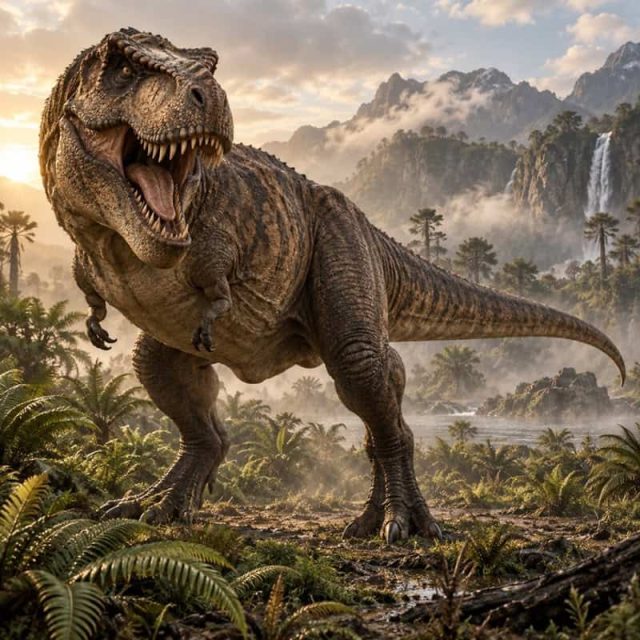
Despite its fearsome appearance, the Erlikosaurus wasn’t a predator. This unusual theropod from the Late Cretaceous has captivated paleontologists and dino enthusiasts alike for its blend of strange features: a body likely covered in feathers, huge curved claws, a toothless beak… and a plant-based diet! So how does this “lizard of Erlik” fit into the dinosaur family tree?
Erlikosaurus
Family
Theropod
Era
Late Cretaceous 90 million years ago
Where he lived?
Asia (Mongolia)
Weight
300 kg
Height
4 m
Length
2,5 m
A rule-breaking theropod
The Erlikosaurus belonged to the therizinosaurs, a family of dinosaurs so peculiar that they puzzled scientists for decades. Unlike classic theropods like the T. rex or the Velociraptor, this group evolved herbivore-like traits: long necks, beaked snouts, and a backward-pointing pubic bone (similar to ornithischians), suggesting a parallel evolution toward a vegetarian lifestyle.
The name Erlikosaurus andrewsi was proposed in 1980 by Barsbold, inspired by the demon Erlik, ruler of the underworld in Mongolian mythology. Ironically, this “demon” was more of a leaf picker than a fierce hunter.
Size, weight, and appearance
Although not one of the largest, the Erlikosaurus had an imposing appearance. Below are its estimated measurements:
| Trait | Estimated Value |
|---|---|
| Total length | 3.4 meters |
| Approx. height | 1.6 m (at the hips) |
| Estimated weight | 150–250 kg |
| Diet | Herbivore |
| Habitat | Mongolia (Bayanshiree Formation) |
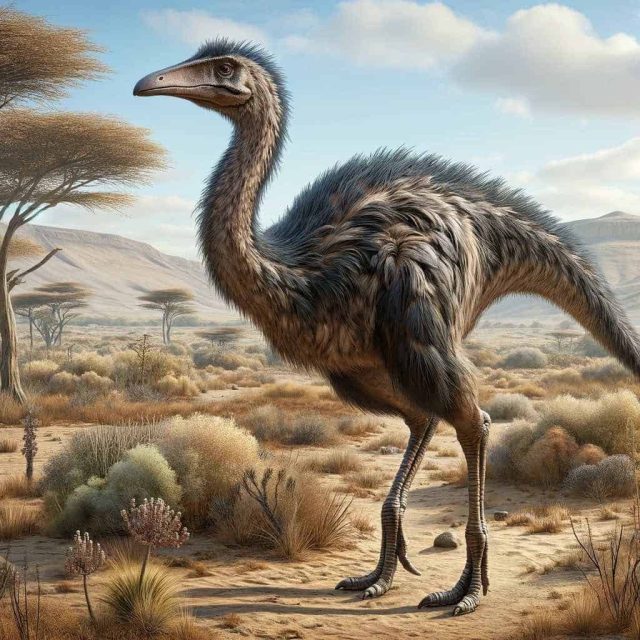
It had a relatively light frame, a long flexible neck, and a narrow skull with a toothless beak—perfect for munching soft vegetation. Its three large curved claws weren’t for hunting, but likely for pulling down branches, defense, or digging.
Did it have feathers?
Though no feather impressions have been found with the Erlikosaurus itself, it’s very likely that it was feathered. This theory is based on close relatives like the Beipiaosaurus, which did have filamentous feathers. Feathers may have helped regulate temperature in Mongolia’s changing climate.
Intelligence and senses
A CT scan of its fossilized skull revealed that the Erlikosaurus had a good sense of balance, hearing, and smell. Even though it was a herbivore, the Erlikosaurus retained sharp senses, likely inherited from carnivorous ancestors.
Diet and behavior
Thanks to its beak and U-shaped jaw, the Erlikosaurus is believed to have been a selective browser, eating leaves, fruit, and soft plants. Some scientists also suggest it used its claws to pull down branches or dig for roots.
It may have lived alone or in small groups, relying on intimidation rather than aggression. Its claws could have also played a role in mating rituals or social displays.
Quick facts
- Had a backward-facing pubic bone, like birds.
- Its claws could reach up to 30 cm long.
- Its skull shows well-developed hearing and smell.
- It’s one of the most artistically inspiring dinos due to its alien-like shape.
FAQs
What did the Erlikosaurus eat?
Plants, soft leaves, fruit, and possibly roots.
Was it dangerous?
Not really—it wasn’t built to attack, but to defend and forage.
Did it live alone or in groups?
No conclusive evidence, but likely in small groups.
Did it have feathers?
Probably yes, based on fossil relatives.
Where did it live?
In what is now Mongolia, around 90 million years ago.
see more dinosaurs
plan your visit