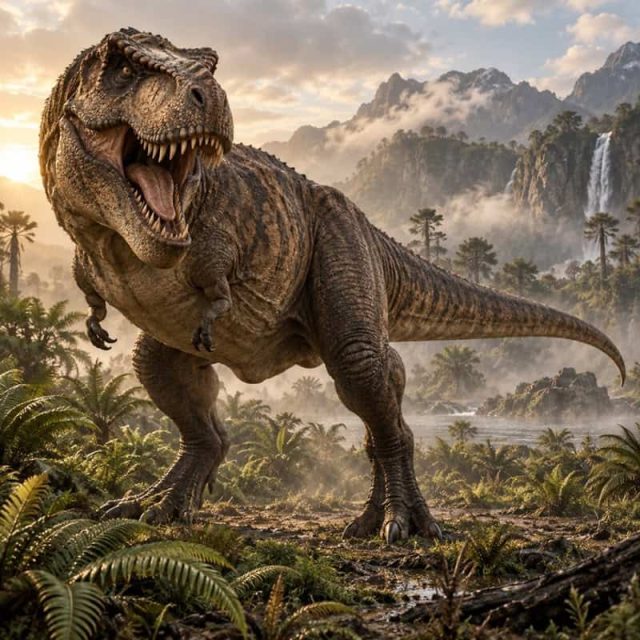
Nanotyrannus (meaning “dwarf tyrant”) is one of the most debated tyrannosaurids in the fossil record. For decades, paleontologists have argued whether it was a valid species or just a juvenile Tyrannosaurus rex. This article explores the most recent evidence and why the debate remains unresolved.
Nanotyrannus
Family
Theropods
Era
Cretaceous Period, about 110 to 100 million years ago.
Where he lived?
Montana, Utah, and Wyoming, USA
Weight
900Kg - 1.500Kg
Height
2m
Length
5m
Features and estimated size
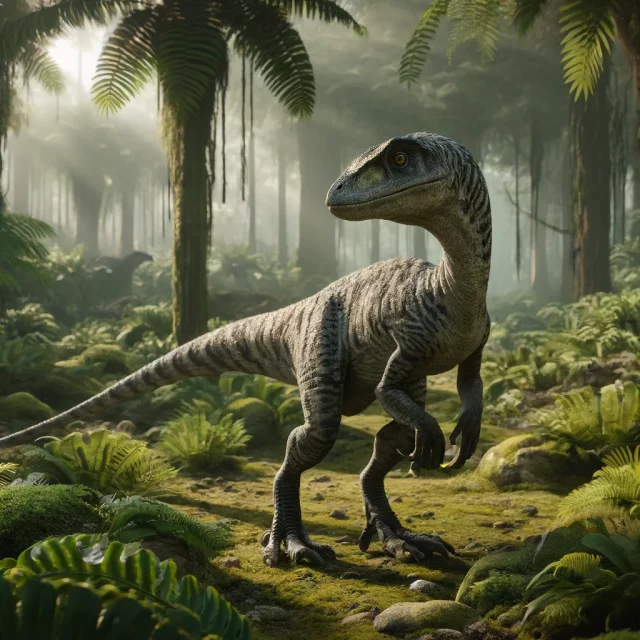
According to both classic and modern studies, Nanotyrannus measured about 5.2 meters in length, 2 meters tall, and weighed between 900 and 1,500 kg. Its skull (around 60 cm) had more teeth (14‑15 per side in the upper jaw vs. 11‑12 in adult T. rex), a key argument for its classification as a separate genus.
Scientific debate: separate species or young T. rex
In 2020, Woodward and Carr claimed that all Nanotyrannus specimens were juveniles under 13 years old, with skulls under 80 cm and juvenile traits consistent with T. rex growth patterns.
In January 2024, Longrich and Saitta published a fossil, histological, and phylogenetic analysis supporting Nanotyrannus as a distinct species, noting slowed growth in some bones and unique cranial features, with no transitional fossils found.

Discovery and debate history
The holotype CMNH 7541, a skull found in Montana in 1942, was initially described as Gorgosaurus and later reclassified in 1988 as Nanotyrannus lancensis due to cranial bone fusion. However, the juvenile skeleton “Jane” led many—including former supporters—to reconsider it as a young T. rex.
While that view remained dominant, the 2024 review by Longrich & Saitta reignited the possibility of a separate genus.
Diet and lifestyle
Like T. rex, Nanotyrannus was a carnivorous apex predator, with jaws full of serrated teeth and strong hind limbs suggesting speed. Some researchers propose it may have hunted in packs, using its smaller size and agility to target juvenile hadrosaurs and ceratopsians.
Nanotyrannus vs Tyrannosaurus rex
| Characteristic | Nanotyrannus | Tyrannosaurus rex (juvenile/adult) |
|---|---|---|
| Length | ~5.2 m | Juvenile ~6 m; adult up to 9–12 m |
| Estimated weight | 900–1,500 kg | Juvenile ~1,000 kg; adult up to ~8,000 kg |
| Teeth (upper jaw) | 14–15 per side | 11–12 per side (adult) |
| Bone development | Slowed adult growth | Rapid growth from juvenile to adult |
| Cranial characteristics | Tooth groove, slimmer jaw | Deep and robust skull |
| Scientific controversy | Ongoing debate | Broadly accepted as valid species |
The mystery of the little tyrant
Nanotyrannus remains one of the most intriguing puzzles among tyrannosaurids. Was it a small, agile predator or just a young T. rex?
At Dinosaurland, we celebrate these scientific mysteries that challenge what we think we know. Nanotyrannus proves that even a small dinosaur can leave a big impact on science.
see more dinosaurs
plan your visit