In February 2026, palaeontologists described the first new Spinosaurus species in over a century. More than 110 years after its first discovery, this dinosaur still forces scientists to rewrite what they thought they knew: how big it was, what its famous sail was for and, above all, whether it really swam or hunted from the shoreline. Here is what we know about Spinosaurus today, what is still being argued about, how it compares to T-Rex, and what to look for when you stand in front of its figure at Dinosaurland.

Spinosaurus
Family
Theropod
Era
Middle Cretaceous, 95 million years ago
Where he lived?
Egypt and Morocco

Weight
20.000Kg
Height
5,4m
Length
15m
What was Spinosaurus and when did it live?
Spinosaurus aegyptiacus, a name that means “spine lizard”, was a large carnivorous theropod dinosaur that lived in the Late Cretaceous, roughly 99 to 94 million years ago. Its fossils come from North Africa: mainly Egypt and Morocco, with material also assigned to the genus in Algeria, Tunisia and Niger.
That Sahara was no desert. It was a world of broad rivers, channels, tidal flats and mangroves, home to huge sawfish, coelacanths such as Mawsonia and giant crocodilians. That setting explains almost all of the animal's anatomy: a predator built to live with its feet in the water.
It is also worth unlearning the movie version. Spinosaurus was not “a bigger T-Rex with a sail”. It was something else entirely: a predator with short hind legs, a narrow crocodile-like snout and conical teeth designed to grip slippery prey rather than crush bone.
How big was Spinosaurus? The real numbers
Inflated figures circulated for years, and you can still read weights of 12 or even 20 tonnes. The most recent and best documented reconstructions are far more modest: the study led by Paul Sereno and colleagues (2022) estimates a maximum length of around 14 metres and a weight of about 7.4 tonnes. The Natural History Museum in London lists exactly those figures in its species profile.
Earlier estimates, based on more fragmentary material, reached 15 metres or more. The honest way to put it: Spinosaurus was probably the longest carnivorous dinosaur we know of, but not the heaviest. Its body was elongated and relatively narrow, not the compact bulk of a tyrannosaur.
To picture it without doing the maths: an animal longer than a city bus, with a sail that in adults rose about a metre and a half above its back. A grown adult human would not reach even half the height of that sail.
Surprising fact: Spinosaurus had unusually dense, solid bones, closer to those of a penguin or a hippo than to the hollow bones of most theropods. A 2022 study in Nature read that density as ballast for controlling buoyancy in water.
The sail of Spinosaurus: the piece nobody has solved
The structure running along its back was not a fat hump or a fin: it was made of greatly elongated neural spinesgrowing stiffly from the vertebrae and joined by tissue. Current reconstructions point to a thin, tall sail of roughly 1.5 metres in the best known specimens.
What was it for? Caution is needed here, because there is no consensus. The three hypotheses on the table are display(attracting mates, recognising members of the same species, intimidating rivals), thermoregulation and some hydrodynamic role. Recent reviews tend to favour display and species recognition as the most likely explanation, and see thermoregulation as less plausible than twentieth-century accounts assumed.
Either way, it was an enormous visual signal. A 14-metre animal carrying a bony screen on its back could be seen from far away, in and out of the water, and that fits a world full of large predators who needed to keep out of each other's way.
Skull, teeth and a crocodile snout
If two regions of its anatomy break the theropod mould, they are the skull and the vertebrae. The snout was long, low and narrow, much like an Orinoco crocodile's, with the nostrils set back towards the eyes: it could dip its jaws into the water and keep breathing.
The teeth tell a clear story too. They were conical and smooth, without the serrated edges typical of big land carnivores. These are teeth for holding, not slicing, and they match the notch that opens near the tip of the jaws: a genuine fish trap. The snout tip also carries small foramina whose distribution has been interpreted as possible pressure receptors, useful for detecting movement in murky water, although that remains a hypothesis.
Add short hind legs, broad feet and a tall, laterally flattened tail with powerful muscles at its base, and you have a body unlike any other dinosaur known.
Did it swim, or hunt from the shore? The big open debate
This is the part that has changed most, and where older profiles go wrong by giving a closed answer. In 2014, Nizar Ibrahim's team proposed Spinosaurus as the first semiaquatic dinosaur. In 2020, the description of a tail with extremely tall spines in Nature strengthened the idea of a propulsive tail able to undulate like an eel's. And in 2022, the bone density study published in Nature added the ballast argument for submerging.
On the other side, also in 2022, Sereno and colleagues published digital models of the animal in eLife and concluded it would have been far too buoyant and unstable to chase prey underwater, describing it instead as a bipedal ambush predator that frequented river and coastal margins. The argument is still very much alive.
So what can be stated confidently? That it ate fish, that it spent much of its life in or beside water, and that it was big enough to scavenge and to hunt small and medium-sized dinosaurs on land. What is unresolved is whether it was an active diver or a specialised shoreline hunter. Telling it as an open question is truer to the science, and a good deal more interesting.
Spinosaurus vs T-Rex: which was bigger (and why the fight is impossible)
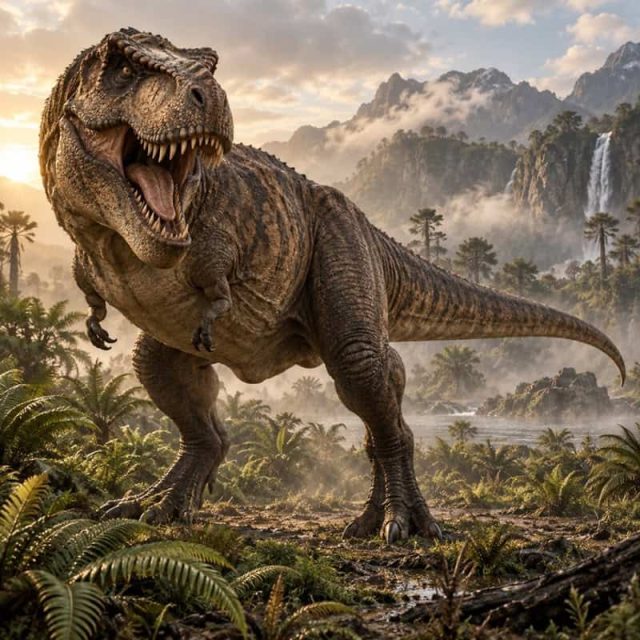
This is the comparison everyone searches for, so here are the numbers, with one caveat first: they never met. Spinosaurus lived around 99-94 million years ago in Africa; Tyrannosaurus rex lived around 68-66 million years ago in North America. Some 30 million years and an entire ocean separate them.
| Feature | Spinosaurus aegyptiacus | Tyrannosaurus rex |
| Age | Cretaceous, ~99-94 mya | Cretaceous, ~68-66 mya |
| Where it lived | North Africa | North America |
| Length | ~14-15 m (longest theropod known) | ~12-13 m |
| Estimated weight | ~7.4 t | ~6-8 t (some estimates higher) |
| Skull | Long and narrow, crocodile-like | Tall, wide and massive |
| Teeth | Conical and smooth, for gripping | Robust and serrated, for crushing bone |
| Bite | Far less powerful | Among the strongest known: estimates of 35,000 to 57,000 newtons |
| Main diet | Large fish, aquatic prey, carrion | Large herbivorous dinosaurs |
The honest summary: Spinosaurus won on length and on sheer visual drama; T-Rex won on mass, bite force and the weaponry needed to fight large prey. They were specialists from different worlds, which is why asking who would “win” says more about our imagination than about palaeontology. If you like this kind of comparison, take a look at our article on carnivorous, herbivorous and omnivorous dinosaurs.
Stromer, the Munich bomb and the 2026 surprise
Spinosaurus was first described in 1915 by the German palaeontologist Ernst Stromer von Reichenbach, from fossils collected at the Bahariya Oasis in Egypt. That first specimen was the finest that has ever existed. And it was lost: Stromer's collection was destroyed in an Allied bombing raid on Munich in 1944, taking the original skeleton with it.
For decades all that remained were Stromer's notes and drawings. Thanks to them, and to later finds in the Kem Kem beds of Morocco, the species could be reconstructed far more precisely from 2014 onwards.
Then, in February 2026, came the twist: a team led by Paul Sereno described a second species of the genus in Science, Spinosaurus mirabilis, found in the Farak Formation of Niger and dated to around 95 million years ago. Its standout feature is a scimitar-shaped cranial crest, and its teeth interlocked like the fingers of two clasped hands. It is interpreted as a giant shallow-water wader and, because it turned up far inland rather than on the coast, it adds another argument to the lifestyle debate. It is the first unquestionable new Spinosaurus species in more than a hundred years.
Spinosaurus at Dinosaurland (Porto Cristo, Mallorca)
At Dinosaurland you can see the Spinosaurus figure at life size, among the more than 100 reproductions along the park trail in Porto Cristo. It is one of the models that works best with children: the silhouette is instantly recognisable and lets you explain three ideas at once — sail, crocodile snout and life beside the water. You can browse the rest of the species in our park dinosaur guide.
A small game for your visit. Stand in front of the figure and look for three details: the height of the sail compared with an adult; the shape of the snout and those smooth conical teeth, so different from the T-Rex you will meet further along; and the length of the hind legs relative to the body, shorter than you would expect in a giant theropod.
The trail is self-paced and includes an interactive raptor show. In high season, buy your ticket online to skip the queue and check the current opening dates and times beforehand, as there are closing days. Our visitor guide helps you plan. And to round off the day, many visitors combine the park with the Hams Caves, a few minutes away in the same area.
Frequently asked questions about Spinosaurus
How long and how heavy was Spinosaurus?
The most recent estimates put Spinosaurus at around 14 metres long and about 7.4 tonnes, based on the 2022 study by Sereno and colleagues and the Natural History Museum profile. Earlier reconstructions reached 15 metres or more. It was probably the longest carnivorous dinosaur known, though not the heaviest: T-Rex was more solidly built.
When and where did Spinosaurus live?
It lived in the Late Cretaceous, roughly 99 to 94 million years ago, in what is now North Africa. The main fossils come from Egypt (Bahariya Oasis) and Morocco. In February 2026 a second species, Spinosaurus mirabilis, was described from Niger, with a striking scimitar-shaped crest.
What was the Spinosaurus sail for?
There is no scientific consensus. The most discussed hypotheses are display and species recognition, thermoregulation and some hydrodynamic function. Recent reviews consider display the most likely explanation. The sail was formed by greatly elongated neural spines and stood about 1.5 metres tall.
Did Spinosaurus actually swim?
This is the liveliest open debate in current palaeontology. Some studies argue it dived and propelled itself with its tail, based on tail shape and unusually dense bones; others conclude it was too buoyant and unstable and hunted from the shore in shallow water. What is clear is that it ate fish and lived closely tied to water.
Did Spinosaurus and T-Rex ever meet?
No. Spinosaurus lived around 99-94 million years ago in Africa and Tyrannosaurus rex around 68-66 million years ago in North America. Nearly 30 million years and an ocean separate them, so any showdown between the two belongs to fiction.
Can you see a Spinosaurus in Mallorca?
Yes. At Dinosaurland in Porto Cristo there is a life-size Spinosaurus reproduction along a trail with more than 100 dinosaurs. The park is self-paced, includes an interactive raptor show and can be combined with the Hams Caves on the same day.
A dinosaur that keeps changing
There is something poetic about Spinosaurus: the best skeleton we ever had vanished in a bombing raid and, a century later, the desert keeps handing back pieces that force us to rethink it. Every find makes it a stranger and more real animal at the same time.
Come and see it up close at Dinosaurland: standing in front of that sail, you understand why we have been arguing about it for a hundred years.

see more dinosaurs

plan your visit