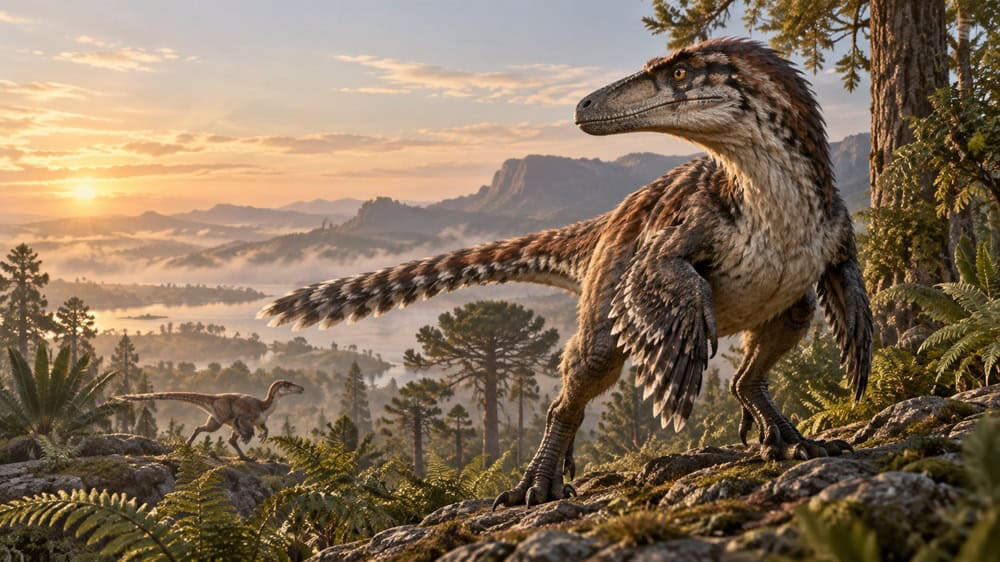

Today we embark on a fascinating journey into the past, a journey that takes us back 65 million years to the time when the lords of the Earth, the dinosaurs, saw their reign come to an abrupt end. Always shrouded in mystery and speculation, the dinosaur extinction event has captured the imagination of scientists and fans alike. But how did the dinosaurs actually become extinct? Was it climate change, a colossal meteorite, or even, as some suggest with a dash of humor, extraterrestrial intervention that sealed the fate of these magnificent creatures? Join us as we unravel the mystery.
Índice
Toggle
How long ago did the dinosaurs become extinct?
The dinosaurs became extinct approximately 66 million years ago, at the end of the Cretaceous period. This moment in Earth’s history marks one of the most significant mass extinctions and is known as the K-Pg boundary. Although it is impossible to pinpoint a specific “year” on the calendar as we know it today, geological and fossil evidence allows us to date this event fairly precisely. Therefore, we cannot give a clear answer to the question: what year did the dinosaurs become extinct? But we can place this tragic event in an era.
How did the dinosaurs die?
At the twilight of the Mesozoic Era, specifically in the Cretaceous Period,The dinosaurs’ peaceful existence was interrupted by a celestial visitor. Traveling at a speed of 20 km per second, a meteorite of unimaginable proportions struck what we know today as the Yucatan Peninsula, Mexico. The energy released by this impact was equivalent to the simultaneous detonation of 50,000 nuclear bombs, marking the beginning of the end for our prehistoric giants. This was the beginning of the dinosaurs’ existence on Earth.
Imagine for a moment millions of tons of burning material being thrown into the air, forming a cloud of burning particles that descended upon the earth, igniting everything in its path. But that wasn’t all; the impact released a massive amount of sulfate into the atmosphere, transforming into sulfuric acid and further complicating the survival not only of the dinosaurs, but of countless species.
The Consequences of the Disaster
The impact not only brought fire from the sky, but also unleashed gigantic waves nearly 100 meters high and caused a megathrust earthquake that shook the entire planet. The combination of these catastrophic events drastically altered the global climate, plunging the world into a “nuclear winter” that blacked out the sun for months, if not years, affecting the food chain from its very base.
Survival of the fittest: In this darkened, cold world, plants died, and with them, the food base of many animals. Dinosaurs, especially the large ones, found it increasingly difficult to find food and survive in this new, hostile environment. However, not all species became extinct; birds, direct descendants of dinosaurs, are a living testament to the ability to adapt and survive. In what era did the dinosaurs become extinct? The Mesozoic Era came to an end with this cataclysm.

Additional factors: volcanoes and climate change
Beyond the devastating asteroid impact, other elements contributed to this dramatic change on Earth. Massive volcanic eruptions, significant climate changes, and sea level fluctuations complemented the impact, creating a hostile environment for life as these creatures knew it. creating a hostile environment for life as these creatures knew it.

Beyond the Dinosaurs
A legacy that endures: Although dinosaurs are extinct, their legacy lives on, not only in the fossils we study but in their winged descendants that soar in our skies. The story of their demise reminds us of the fragility of life on our planet and the importance of understanding our past to protect our future.
In conclusion, the extinction of the dinosaurs was the result of a chain of catastrophic events triggered by the impact of a meteorite. This event not only changed the course of life on Earth but also paved the way for the evolution of new life forms, including us humans. At Dinosaurland we celebrate the amazing history of these incredible creatures and invite you to explore, learn and marvel at the world that was once home to the dinosaurs. Join us on this journey through time and discover the secrets that the past has in store!