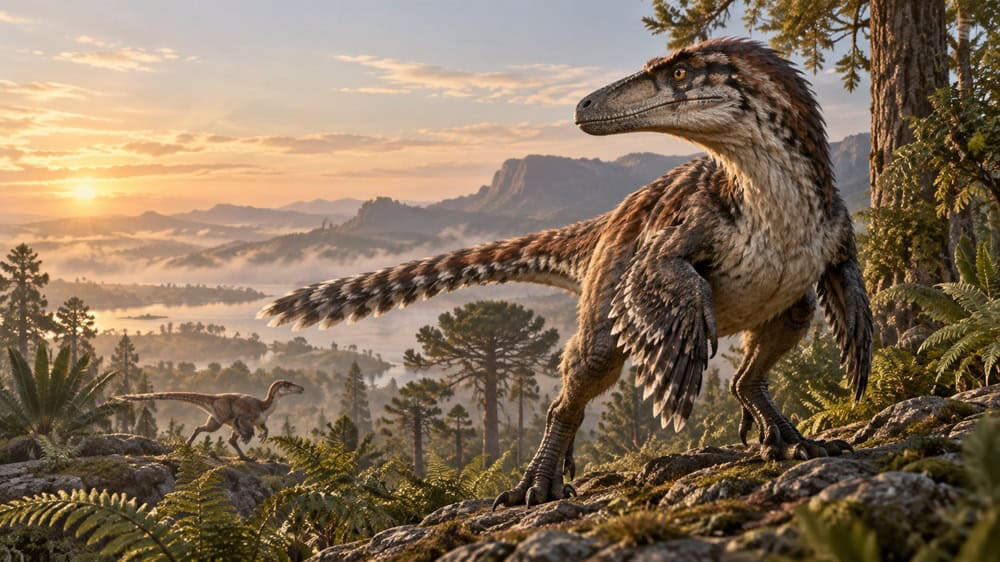

When we think of the age of the dinosaurs, the image that springs to mind is usually the animal itself: a Tyrannosaurus hunting, a Diplodocus eating leaves, a pterosaur gliding over a valley. But we rarely ask ourselves what was beneath their feet. What kind of trees formed those forests, what plants covered the ground, what the landscape where they lived for over 160 million years actually looked like.
The answer is that the forests of the Mesozoic were unlike anything that exists today. There was no grass. There were no meadows. There were no flowers for most of that era. What there were, were tree-sized ferns, conifers that bear no resemblance to any modern pine and plants with shapes that today survive only as botanical curiosities in specialist gardens.
Understanding those forests means understanding the world of the dinosaurs. Because the vegetation was not just the backdrop: it was the foundation of the entire food chain and the factor that determined where they could live, what they could eat and how they evolved. Throughout this article we will trace how those forests changed across the Triassic, the Jurassic and the Cretaceous, which plants the different dinosaurs ate, which of those species are still alive today and where you can see that prehistoric world recreated.
The Triassic: the first forests of the dinosaurs
The Mesozoic begins 252 million years ago, right after the greatest mass extinction in Earth’s history (the Permian–Triassic extinction, which wiped out 90% of marine species and 70% of terrestrial ones). The planet was devastated and ecosystems took millions of years to recover.
The earliest Triassic forests were simple. They were dominated by tree ferns (ferns that grew up to 10–15 metres tall, with woody trunks and canopies of fronds) and by giant lycopsids, relatives of plants that today barely reach a few centimetres but back then formed trees several metres tall.
Primitive conifers began to diversify during the Triassic, but they did not yet dominate the landscape. Also common were cycads, plants that look like short palms with stiff leaves and produce reproductive cones similar to pine cones. Cycads were a fundamental food source for the earliest herbivorous dinosaurs.
The ground was covered with mosses, liverworts and small ferns. There was no grass: grasses would not appear for many millions of years yet. The landscape looked more like a modern tropical rainforest of giant ferns than any European woodland.
The Jurassic: the green explosion
The Jurassic (201 to 145 million years ago) was the golden age of Mesozoic forests. The climate was warm and humid across most of the planet, and the vegetation responded with unprecedented diversity.
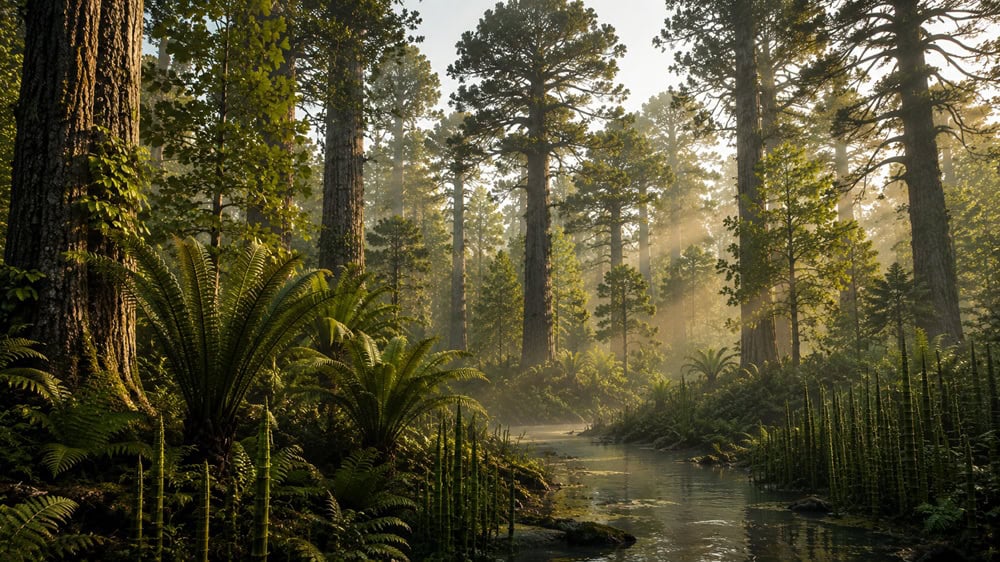
Jurassic forests were dominated by three plant groups that feel only half-familiar today. Conifers were the rulers of the landscape: araucarias, primitive cypresses and other groups formed dense forests that reached 30 to 40 metres in height. Araucarias, which still survive in Chile, Argentina and Oceania, dominated much of the planet back then, and their straight trunks and symmetrical crowns drew a landscape very different from a modern Mediterranean pine wood.
Alongside them thrived the cycads, which reached their peak diversity in the Jurassic, from low shrubs to trees several metres tall; their thick, leathery leaves were the staple food of great sauropods such as Diplodocus and Brachiosaurus. The third protagonist was the ginkgo, that ornamental tree we see today in parks and avenues and the sole survivor of a group that then included dozens of species. Its fan-shaped leaves appear in the fossil record on every continent.
The ground was still dominated by ferns, but new groups of small plants appeared. Horsetails (Equisetum) formed dense thickets along rivers and lakes, creating riparian ecosystems that served as refuge for small dinosaurs and for the earliest mammals.
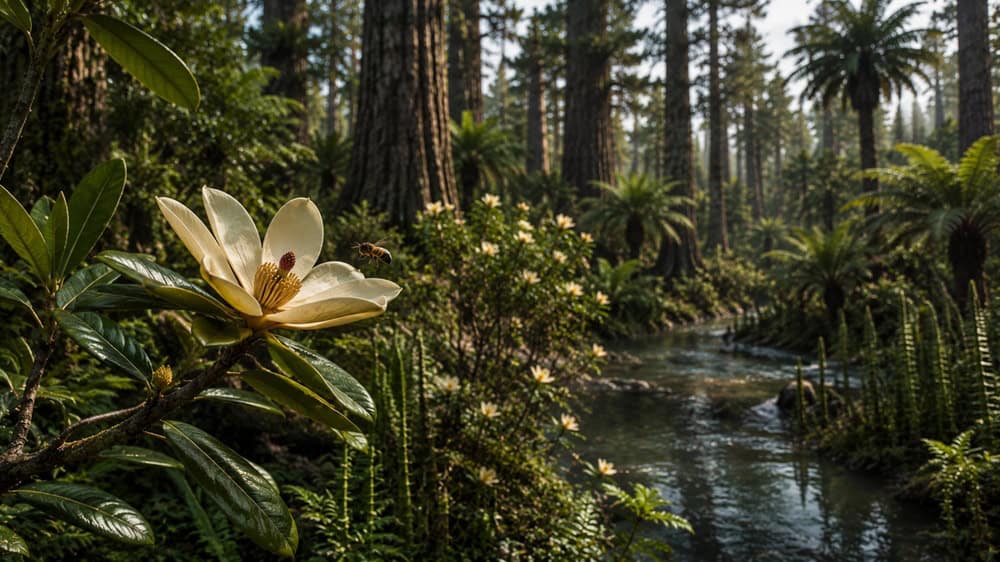
During the Jurassic there was neither grass nor flowers. The forests were made up of conifers such as araucarias, palm-like cycads and ginkgos. Ferns covered the ground and horsetails lined rivers and lakes. A landscape radically different from any modern forest.
The Cretaceous: the flower revolution
About 140 million years ago, in the Early Cretaceous, something happened that would change life on Earth forever: the first flowering plants (angiosperms) appeared. It was a quiet revolution that took millions of years to play out, but it ended up transforming ecosystems entirely.
The earliest angiosperms were small plants, probably aquatic or semi-aquatic. But their evolutionary advantage was enormous: they produced fruits that protected their seeds and attracted animals to disperse them. Within a few million years, flowering plants began to colonise every environment.
By the Late Cretaceous (100–66 million years ago), forests had changed radically. Magnolias, sycamores, primitive fig trees and palms coexisted with the conifers that had dominated during the Jurassic. The understorey filled with flowering shrubs and the first pollinating insects (primitive bees, butterflies) established relationships with the new plants.
This shift had direct consequences for dinosaurs. The hadrosaurs (duck-billed dinosaurs) of the Late Cretaceous had teeth adapted for chewing the tougher leaves of angiosperms. Ceratopsians like Triceratops could shear woody stems with their beaks. Herbivore diets diversified alongside the flora.
Plants that outlived the dinosaurs
Several of the plants that made up Mesozoic forests are still alive today. They are genuine living fossils that let us see, touch and smell what the dinosaurs ate. Modern tree ferns of the genera Cyathea and Dicksonia, which grow in the tropical rainforests of Australia, New Zealand and South America, descend directly from the ferns that covered the Jurassic floor. And araucarias, such as the Chilean araucaria (Araucaria araucana) or the Norfolk Island pine (Araucaria heterophylla), belong to the same genus that dominated those forests; their nuts probably fed the smaller dinosaurs.
The most astonishing case is the Ginkgo biloba, the only surviving species of its group, whose leaf has barely changed in 200 million years and is almost identical to that of its Jurassic ancestors. Something similar happens with cycads, of which around 300 species remain in tropical and subtropical regions, keeping the same look they had 200 million years ago, and with horsetails (Equisetum), scaled-down versions of plants that in the Mesozoic reached several metres tall, as documented by the educational website Humanidades.
The forest that never was: debunking myths
Films and popular illustrations tend to depict Mesozoic landscapes with palm trees, green grass and colourful flowers. That picture is almost entirely wrong for most of the era.
There was no grass until the Late Cretaceous (and even then it was scarce). There were no flowers until 140 million years ago. Palms did not appear until the Cretaceous. And the dominant colour of the ground was not the bright green of a lawn but the brown and dark green of ferns and conifer leaf litter.
The real landscape was darker, damper and quieter than we usually imagine. Without buzzing pollinating insects (until the flowers arrived), without birdsong (birds appeared in the Jurassic but were rare), the Mesozoic forest was a place dominated by the sound of wind through conifers and the crunch of leaf litter under dinosaur feet.
If you want to see what the world these animals lived in looked like and walk among life-size replicas, at Dinosaurland you can explore over 100 dinosaurs set in a natural environment that evokes those prehistoric landscapes. And if you are curious about the other side of the food chain, take a look at the diet of carnivorous dinosaurs: the hunters that shared these forests with the herbivores.
Walk through the Mesozoic forests at Dinosaurland
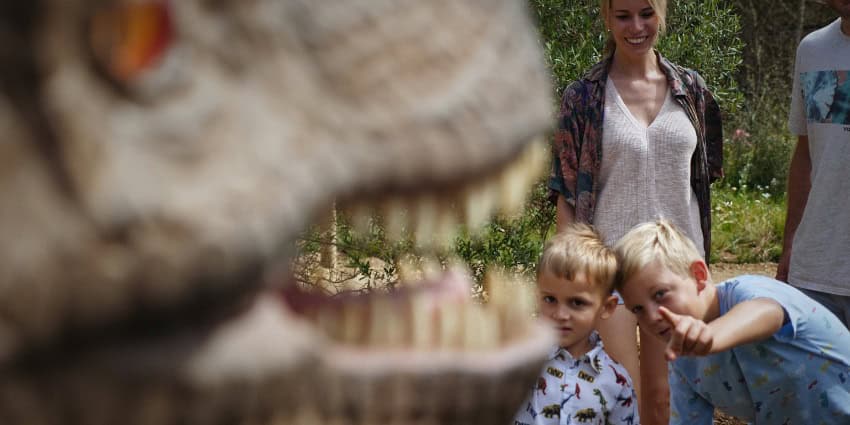
You do not need a time machine to picture that world. At Dinosaurland, in Porto Cristo (Mallorca), the trail winds through pines, palms and Mediterranean vegetation that recreates the feel of a prehistoric forest, with more than 100 life-size dinosaurs scattered across the garden. It is a plan designed for families: children learn to tell a long-necked herbivore from a hunter while they play, and the circuit takes a comfortable one to two hours.
The park is just a few minutes from the Cuevas dels Hams, so many families combine both visits in a single day with the Dinos&Caves pass. To skip the queues it is worth buying your ticket online and checking the up-to-date opening times on the official Dinosaurland website before you go, as they change with the season.
Frequently asked questions about Mesozoic forests
What plants did dinosaurs eat?
It depended on the period. In the Triassic and Jurassic, herbivores ate mainly ferns, cycads, conifers and ginkgos. From the Cretaceous onwards, flowering plants were added (magnolias, primitive fig trees, palms). Long-necked sauropods fed on conifer canopies; smaller herbivores ate ferns and cycads in the understorey.
Did grass exist in the age of the dinosaurs?
Grasses appeared in the Late Cretaceous (about 80 million years ago), but they were scarce and of limited distribution. The vast grasslands that today cover entire continents did not exist until the Cenozoic, millions of years after the dinosaurs went extinct.
Which plants from the dinosaur era are still alive today?
Several: tree ferns, araucarias, ginkgo biloba, cycads and horsetails. All of them are direct descendants of plants that lived alongside dinosaurs and retain forms very similar to those of their Mesozoic ancestors.
Why was the appearance of flowers so important?
Flowering plants (angiosperms) produced fruits that attracted seed-dispersing animals, which allowed them to colonise new habitats faster than conifers. They also established relationships with pollinating insects that accelerated their diversification. Within a few million years they went from being marginal plants to dominating terrestrial ecosystems.
The dinosaurs disappeared, but the forests that fed them never entirely went away. Every time you see a ginkgo on a pavement, a fern in a pot or a horsetail beside a stream, you are looking at a survivor from the world of the dinosaurs. And to see them surrounded by their ancient inhabitants, all you have to do is take a walk through Dinosaurland.