
Mallorca works well with kids for one very practical reason: almost everything is less than an hour away by car. You can have breakfast in Palma, spend the morning among dinosaurs on the east coast and finish the day on a beach where the water is still ankle-deep twenty metres out.
Índice
ToggleThis guide sorts the options by the thing that actually decides your day: how old your children are. It also covers what to do when it rains, what costs nothing, where to stay depending on the area, how to get around, and three complete days already put together. With prices and timings, not adjectives.
The basics before you plan anything
Mallorca is 100 kilometres from end to end and the drive between areas rarely takes more than an hour, so you can stay in one place and move around every day without changing hotels. May, June and September are the best months with children: the sea is warm, there is room everywhere and none of the August heat. A hire car saves a lot of time, though the east coast and the north are perfectly doable by bus. And one piece of local advice: two activities a day, maximum — one in the morning and something gentle in the afternoon.
The plan depends on their age, not on the catalogue
Most “things to do with kids” lists work exactly the same for a two-year-old and a teenager, which is why they work for nobody. Put the age first and the decision makes itself.
From 0 to 3, logistics rule: shallow beaches, flat walks where the pushchair is not a problem, and nothing that runs longer than two hours. What they see matters less than how well the nap gets solved.
From 4 to 8 is the age band where almost everything works, and where anything that moves, can be touched or has to be found lands best: animatronic dinosaurs, fossil digs, aquariums, farms. It is also the age at which a well-planned day gets remembered for years.
From 9 to 12 they start asking for real adventure: snorkelling, kayaking, zip lines, walks with some actual climb to them. And from 13 upwards the trip looks a lot like an adult one, with the difference that they need to choose something themselves every day.
Dinosaurland, the family day out that wins
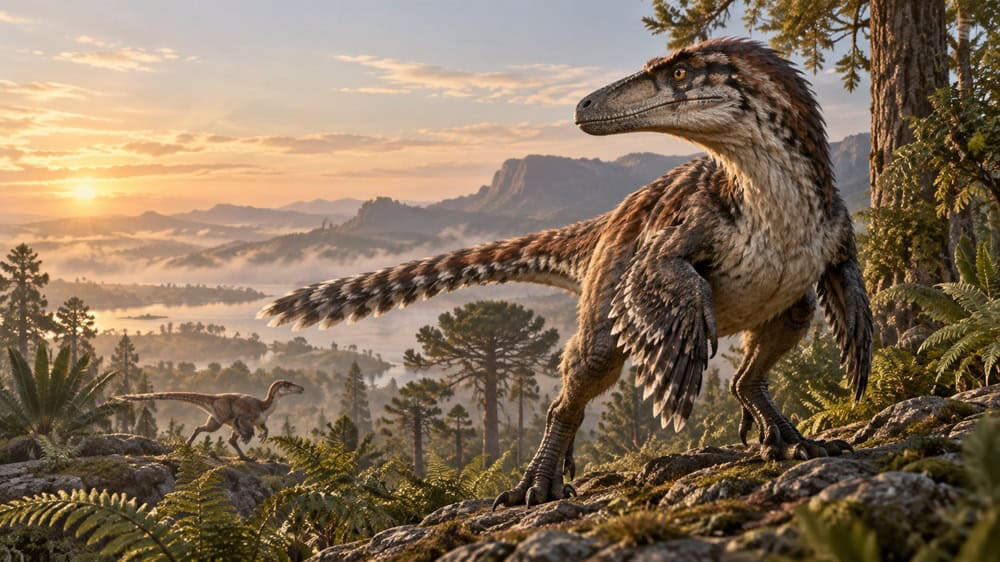
In Porto Cristo, on the Ma-4020 road towards Manacor at kilometre 11, there is a pine wood with more than 100 life-size dinosaur replicas from around 40 species. Many of them are animatronic: they move and roar when someone comes close, triggered by sensors.
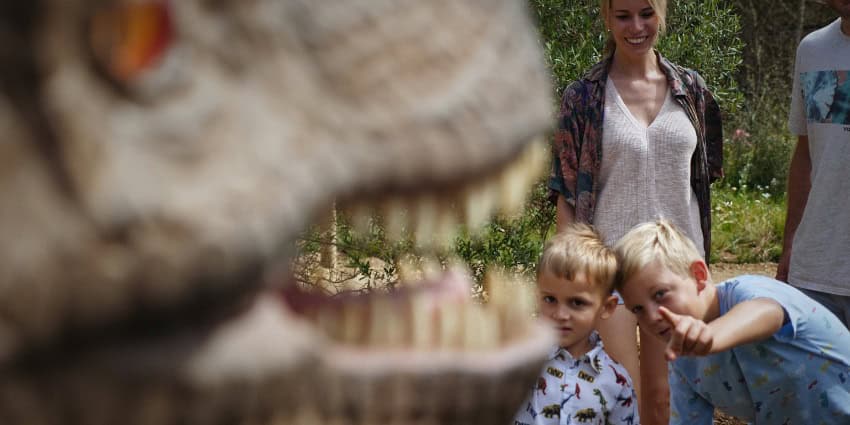
That is what hooks children, not the number of pieces. The face a five-year-old makes when a twelve-metre Tyrannosaurus turns its head towards them is not something an information panel can produce. There is also the Triceratops, the Velociraptor, and a twenty-metre Titanosaur you can see from half an hour before you reach it.
The route is self-guided and free-flowing: no group time, no guide setting the pace. You stop where you want, skip what bores them and go back to see the same dinosaur again, which with small children always happens.
What the ticket includes
As well as the trail through the pines, the ticket includes the Explorer Zone, a recreated palaeontology camp where children dig for fossil remains, with games and puzzles. It is where they stay longest and where getting them to leave is hardest.
It also includes the live Ranger show, which runs several times a day in Spanish and in English. Times are announced at the park on the day itself. One warning that parents of the youngest ones appreciate: the raptor moves among the audience and even climbs the steps of the seating area. Most children love it, but at two or three the back rows are the better seat.
And the park map, handed out at the ticket desk, plus the photo spots along the route.
Prices and the practical side
Tickets from 13 upwards cost €19.50 at the desk and €18.50 online; the child ticket, ages 3 to 12, is €13.50 and €12.50. Under-3s go free, up to two per adult over 18. Buying online saves a euro per ticket and is the only saving available to the general public.
The visit takes around an hour and a half: enough to walk the whole thing, spend time in the Explorer Zone and catch the show. The path is flat and adapted, so it works with a pushchair and with a wheelchair. Parking is free and right at the entrance, though in July and August it fills up by mid-morning.
You can bring your own food and drink, though it is worth knowing there is no designated eating area inside the grounds: the picnic tables are outside. There is a café inside, and at the entrance and exit you will find Dinoburger, with smash burgers, salads and a children’s menu that comes with a gift.
Book your tickets at tickets.dinosaurland.es and save €1 per ticket compared with the desk price. For the full breakdown of rates and discounts, see tickets, prices and how to book, and for everything worth having ready before you arrive, the parents’ guide.
And right next door, the Cuevas dels Hams
On the same site, adjacent to the park and a couple of minutes’ walk away, are the Cuevas dels Hams. Entry is by timed slot and you walk around 500 metres with a guide who stays with the group, at a constant 20 °C all year round.
You pass through the Cueva Redonda, now open to the sky and turned into a garden with native birds living freely; the Cueva Azul, with the documentary “Discovering the Past”; and the Cueva Clásica, with the underground lake known as the Sea of Venice and its musical show over the still water. In the Dream of an Angel chamber you will find the hooks that give the cave its name: needle-thin formations that start growing downwards and, at a certain point, curve and rise again.
The combined Dinos & Caves ticket covers both attractions on the same day and costs €27 from 13 upwards and €21 for ages 3 to 12 at the desk, or €26 and €20 online. Against two separate tickets, that is eleven euros less per adult.
Two things to know before buying it. Pushchairs cannot go into the caves — there is an area next to the ticket desk to leave them — and the route has 217 steps up and 148 down. If anyone in your group has reduced mobility, the individual park ticket is the better buy, as the park itself is fully accessible.
Beaches where the water stays shallow
Almost every beach in Mallorca works with children, but a handful are noticeably better: the ones tucked at the back of a sheltered bay, where the water deepens very slowly and no swell gets in.
Cala Agulla, in the north-east, is wide, fine-sanded and has every service within reach of your towel. Cala Millor, on the east coast, has nearly two kilometres of sand and a flat promenade that works well with a pushchair. And Porto Cristo beach, 300 metres long, sits inside the village itself, with bars and toilets thirty metres away, so it slots effortlessly onto the end of a morning at the park.
The full run-through, with what each one offers, is in the best beaches in Mallorca for kids.
Water, slides and a bit of adrenaline
When the beach has given all it has to give, a water park fills an entire day. Mallorca has several, with separate areas for the little ones and slides in every size; Western Water Park, in Magaluf, is among the best known. They are all compared in water parks in Mallorca.
For age nine and up, Jungle Parc in Palma runs zip-line and rope-bridge circuits through the trees, graded by difficulty. The full write-up is in Jungle Parc Mallorca.
And if you would rather see the island from the water, half-day boat trips leave from several ports, many with glass bottoms and a swimming stop in coves no road reaches: family boat trips.
Nature without anyone ending up in tears
The classic mistake is taking a family with small children into a Serra de Tramuntana hike. Mallorca has short, flat trails that work far better.
Mondragó Natural Park, in the south-east, combines a waymarked path, woodland and two undeveloped beaches at the end of the walk, which is exactly the kind of reward you need. S’Albufera, in the north, is a flat wetland with bird hides where children will happily spend a morning behind a pair of binoculars.
There is a selection of routes built for short legs in hiking in Mallorca with kids, and if you would rather be on wheels, in family cycling routes. For a quiet day in the countryside, the educational farms of rural Mallorca let children feed the animals, and the island’s picnic areas solve lunch outdoors without hunting for a restaurant.
Palma with kids
The capital is good for two or three days without repeating yourself. Palma Aquarium holds one of the largest collections of marine life in the Mediterranean and runs workshops for younger visitors; it is covered in a day at Palma Aquarium and set against the alternatives in the best aquariums in Mallorca.
The old town is walkable, and the climb up to Bellver Castle pays out in views across the whole bay. Several of the city’s museums run children’s programmes and adapted exhibitions, gathered in museums and galleries to visit with children.
Days out that cost nothing
Not everything has to go through a ticket desk. Beaches and coves are free and many have public showers and toilets. The weekly village markets — Porto Cristo’s is on Sunday morning — make for an hour that children enjoy more than you would expect.
The natural parks are free to enter on foot, and the island’s lighthouse route is driven stopping wherever you feel like it, with no entry fee at any point. In Palma, wandering the old town and seeing the cathedral from outside costs nothing either.
If you wake up to rain
It does not happen often, but when it does it tends to wreck the whole schedule, because almost every family plan in Mallorca is outdoors.
The combination that works best is having half a day under cover: the Cuevas dels Hams are indoors, and down there the weather makes no difference, at the same temperature all year. The aquarium, the museums in Palma and the children’s workshops cover the rest of the day. If heavy rain is forecast and you can pick your date, everything is more enjoyable in good weather.
Where to stay, depending on what you want
The area matters more than the hotel, because it decides how much of each day you spend in the car.
The north, between Alcúdia and Can Picafort, has the longest beach and the calmest water on the island, and it is the area with the most family hotels with pools and entertainment. The east, around Porto Cristo, Cala Millor and Sa Coma, is quieter and puts the park, the caves and half a dozen coves within twenty minutes. The Palma area has the airport, the city and the indoor options close at hand, and it is the best choice if you are not hiring a car. And the interior, with its agroturismos and country houses, works very well with children who need space to run.
Three days already planned
If you want something ready-made with no thinking involved, these three work:
- Dinosaurs and beach. Dinosaurland in the morning, lunch nearby and the afternoon on Porto Cristo beach or at Cala Millor. This is the day that lands best with children aged 4 to 10.
- A full day underground and among the pines. The combined Dinos & Caves ticket covers both attractions without moving the car. Allow around three hours for the full experience, counting the walk from one to the other and a stop to eat, and you still have the whole afternoon free.
- A day in Palma. Aquarium in the morning, lunch in the old town, castle in the afternoon and ice cream on the promenade. Doable start to finish without a car.
Same advice for all three: fix whatever has a set time first, then build the rest around it.
Frequently asked questions
What is there to do in Mallorca with kids?
The options that work best are shallow-water beaches, a theme park like Dinosaurland, the Cuevas dels Hams, the water parks, Palma Aquarium and the short trails in the natural parks. With children, two activities a day is the pace everyone can sustain.
What is the best age to take children to Dinosaurland?
Between 4 and 10 is where it lands best, because the animatronics and the digging area are pitched at exactly that age. Under 3 it works too — the route is flat and pushchair-friendly — although the Ranger show is better watched from the back rows.
How much does a family day at Dinosaurland cost?
A family of two adults and two children pays €62 buying online. With the combined ticket that adds the Cuevas dels Hams, it comes to €92. Under-3s go free.
How long does the visit take?
Around an hour and a half, counting the full route, the Explorer Zone and the Ranger show. With the combined ticket, allow around three hours for the whole experience.
Can I take a pushchair?
Into the park, yes: the path is flat and adapted. Into the caves, no, because the route has steps; there is an area next to the ticket desk for leaving pushchairs.
What is there to do in Mallorca with kids when it rains?
The Cuevas dels Hams are indoors and stay at the same temperature all year, so rain makes no difference to them. Palma Aquarium, the museums with children’s programmes and the workshops cover the rest of the day.
Which is the best area of Mallorca for families?
The north, between Alcúdia and Can Picafort, for its long calm-water beaches and its family hotels. The east, around Porto Cristo, is quieter and puts the attractions and the coves within twenty minutes. Palma makes sense if you are not hiring a car.
When is the best time to visit Mallorca with children?
May, June and September. The sea is already warm, you park without circling, there is room on the beaches and none of the August heat. July and August have more atmosphere and more queueing everywhere.
Are there free things to do with kids in Mallorca?
Yes: the beaches, the weekly village markets, the trails in the natural parks, the lighthouse route and wandering Palma’s old town. That is several days without going near a ticket desk.
Can you visit Mallorca with kids without a car?
You can, though it limits you. The TIB bus network connects Palma with the coast: the 401, for instance, stops in Porto Cristo and at the Dinosaurland site itself. For the smaller coves and the interior, a car saves an enormous amount of time.
What they take home with them
What lasts from a trip to Mallorca with children is rarely the list of places. It is one loose moment: the first time the water reaches their waist without any fear, or the exact second something the size of a bus turns its head and roars three metres away.
Those moments cannot be planned, but you can leave room for them. All it takes is not filling the diary.
If you want that day to be the dinosaur one, tickets are at tickets.dinosaurland.es.