Dinosaurs, prehistoric creatures that dominated the Earth for millions of years, display a surprising diversity in morphology and adaptations. Among the fascinating features that some of these giant reptiles exhibited are the spikes and crests that adorned different parts of their bodies. These structures, present in species such as Parasaurolophus and Stegosaurus, spark the interest of scientists and paleontology enthusiasts, who wonder about their function and usefulness in the lives of these ancient beings.
Índice
ToggleDinosaurs with Spikes on Their Backs
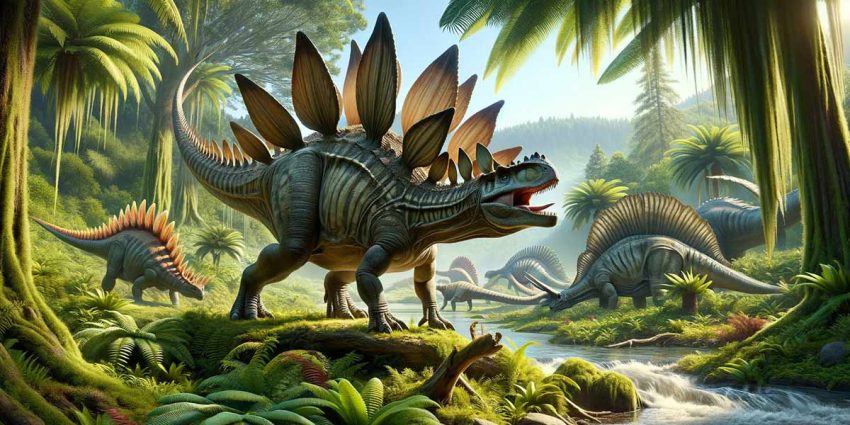
Stegosaurus, one of the most iconic and recognizable dinosaurs of the Late Jurassic, is famous for its distinctive row of bony plates along its back. These spikes, known as dorsal plates, were shield-like bony structures that projected vertically from its spine. Although several theories have been proposed regarding their function, the most widely accepted theory suggests that these plates may have played a role in regulating Stegosaurus’s body temperature. These structures are thought to have helped control body temperature by acting as heat dissipation devices, allowing the animal to cool or warm depending on environmental conditions.
Advances in paleontology have allowed for more detailed study of Stegosaurus’s plates. Recent studies have used three-dimensional modeling techniques and biomechanical analysis to better understand the function and anatomy of these structures. For example, it has been shown that the plates were connected by soft tissue, suggesting they could move and change position, potentially for temperature regulation or display. Despite all this, many questions remain.
Dinosaurs with a crest on their heads
On the other hand, Parasaurolophus is known for its distinctive cranial crest, a hollow bony structure that extended from the back of its skull. This crest, which resembles a long, curved tube, has puzzled scientists for decades. Several hypotheses have been proposed about its function, including vocal resonance for communication, thermal regulation, and sexual display. Regarding the latter, it is believed that, as in other animals, the crest could have played an important role, due to the differences in size and shape, which could have been signals of genetic quality or physical condition during mate selection.
The most widely accepted theory suggests that Parasaurolophus used its crest as a resonating chamber to produce distinctive sounds, allowing it to communicate with other members of its species over long distances.
Advances in technology, such as computed tomography and 3D modeling, have allowed scientists to examine the internal structure of the Parasaurolophus crest in greater detail.
Crested Dinosaurs
In addition to the crests and spikes on their heads and backs, some dinosaurs exhibited crests along their backs. These crests, although less common than the dorsal plates of Stegosaurus or the cranial crests of Parasaurolophus, also raise questions about their function. Examples of crests have been found in dinosaurs such as Spinosaurus, Suchomimus, and Ouranosaurus. Although the exact function of these crests is still a matter of debate, it is thought that they may have played a role in sexual display, thermoregulation, or even protection from predators.
Some researchers suggest that the crests could have served as fat storage areas, especially during times of food shortages. This energy reserve could have been crucial to their survival during periods of famine or drought.
Dinosaurs with Spiked Tails
Another example of dinosaurs with distinctive bone structures are those that possessed spikes on their tails, such as the famous Ankylosaurus. This armored dinosaur was equipped with a series of spike-like ossifications along its tail, which it likely used as defense against predators. These spikes could have been intimidating weapons to deter potential attackers or to inflict damage if attacked.
Dinosaurs with spikes and crests exhibit a variety of morphological adaptations that suggest diverse and complex functions. From thermoregulation to communication and self-defense, these bony structures offer fascinating clues about the life and behavior of these ancient reptiles. As paleontologists continue to discover new fossils and refine our understanding of dinosaur anatomy, we will likely continue to unravel the mysteries behind these astonishing anatomical features.