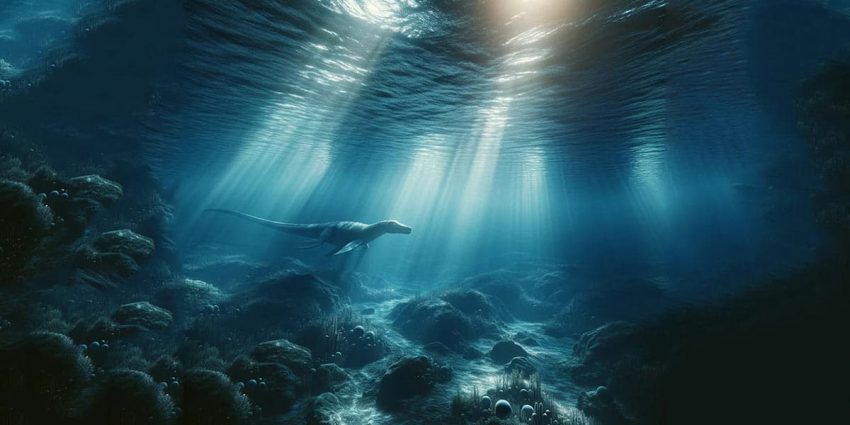
Delve into the exciting prehistoric world and discover the giants that once dominated the oceans of our planet. From the formidable Mosasaurus to the majestic Plesiosaurusand other titans of the sea, marine and aquatic dinosaurs offer us a window into a past full of mystery and wonder. In this fascinating journey, we will explore how these creatures lived, how they adapted to their underwater environments and the impact they have had on today’s marine animals.
Índice
ToggleWhich dinosaurs were aquatic?
The oceans of the past were inhabited by an amazing diversity of marine and aquatic dinosaurs. In addition to Mosasaurus and Plesiosaurus, the prehistoric ocean was home to Elasmosaurus, a close relative of Plesiosaurus, famous for its extremely long neck, which it used to surprise its prey from a distance.
We could also find in the aquatic depths the Ichthyosaurus. These “lizard fish” had streamlined bodies and fins, similar to modern dolphins, perfect for cutting through the waters in search of food.
The aquatic inhabitants were not spared from having a ferocious predator in their oceans, the Liopleurodon, with its enormous teeth and powerful bite, was capable of tearing apart the most resistant prey .
These colossi adapted their bodies in extraordinary ways to dominate the seas, from developing fins to evolving hydrodynamic shapes that allowed them to move gracefully and efficiently through the water.
Unique Adaptations for Survival
The adaptations of aquatic dinosaurs are a testament to the incredible diversity of life and evolution. Their bodies were perfectly suited to life in the water, with features such as:
- Fins or limbs modified for efficient swimming.
- Hydrodynamic bodies to minimize water resistance.
- Large eyes or echolocation systems for hunting in the ocean depths.
The Legacy of Aquatic Dinosaurs
Although marine dinosaurs left no direct descendants, their legacy lives on in the survival strategies and physical adaptations of today’s marine life. For example, the hunting strategies of Mosasaurus can be reflected in the ambush methods of modern sharks. The Ichthyosaurs with their dolphin-like forms, show us how different species can evolve convergently to adapt optimally to similar environments.
In addition, the study of aquatic dinosaur fossils has provided crucial information about the evolution of marine ecosystems and how prehistoric changes, such as mass extinctions, have shaped life on Earth to the present day. These findings help us better understand the importance of preserving our oceans and the biodiversity they harbor.
A Journey into the Maritime Past
The exploration of marine and aquatic dinosaurs opens a door to a prehistoric world of wonders and discoveries. It reminds us of the complexity of life on our planet and the constant evolution of species to adapt to their environments. At Dinosaurland located in Porto Cristo, Mallorca, we invite you to immerse yourself in this journey into the past, where giants of the ocean await to reveal their secrets and show you the unbreakable connection between the past, present and future of marine life.