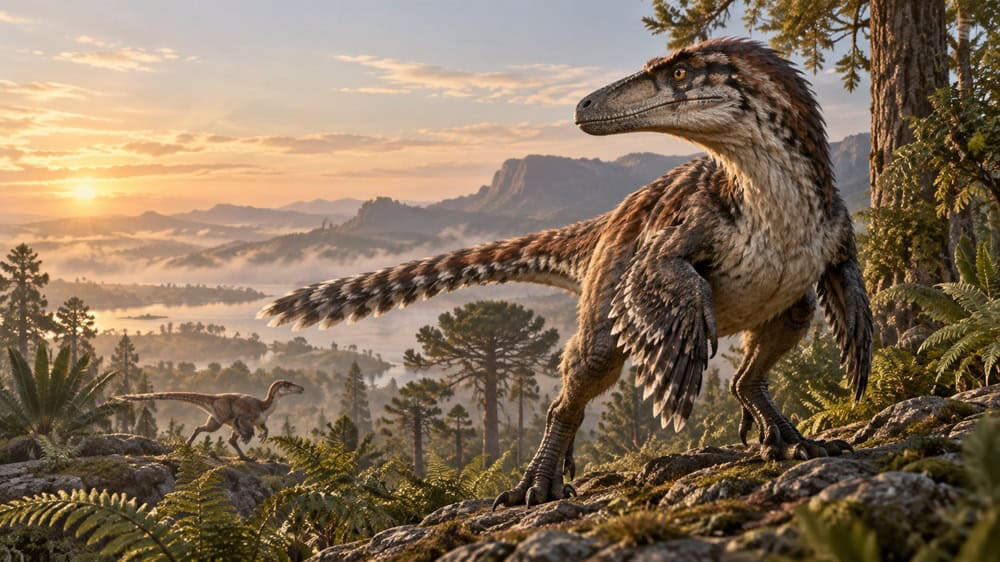

When we think of fast dinosaurs, the image that usually springs to mind is a Velociraptor chasing someone down a corridor. But the palaeontological reality is different. The Velociraptor was not especially fast compared with other dinosaurs. The true sprinters of the Mesozoic were animals that, at first glance, do not look particularly threatening: the ornithomimids, a group of theropods with an ostrich-like body, long legs and a toothless beak.
These dinosaurs did not run to hunt. They ran to survive. In a world full of predators with jaws capable of crushing bone, speed was the best possible defence. And some of them could exceed 60 km/h.
To put that in perspective: Usain Bolt reached 44.72 km/h during his 100-metre world record. An Ornithomimus would have left him behind without breaking a sweat.
Ornithomimids: the ostrich dinosaurs
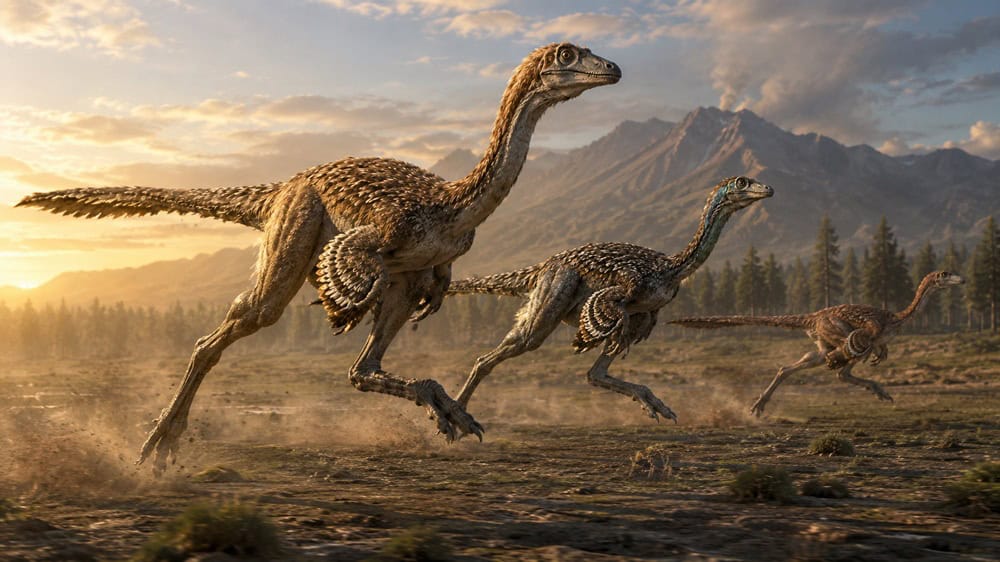
The ornithomimid group (“bird mimics”) includes the fastest known dinosaurs. They all share a very similar body plan: small head, long neck, lightweight body, relatively short arms and long, muscular hind legs. Their resemblance to modern ostriches is no coincidence — it is the result of the same evolutionary pressures. When survival depends on outrunning the predator chasing you, the body optimises itself for speed.
The three main contenders for the title of fastest dinosaur are:
Ornithomimus
Its name means “bird mimic”. It measured about 3.5 metres long, weighed between 100 and 170 kilograms and lived in North America during the Late Cretaceous (around 70 million years ago). Speed estimates vary, but most studies place it between 50 and 70 km/h. It was omnivorous: its toothless jaws allowed it to eat everything from insects and small animals to seeds and fruit.
Gallimimus
The “chicken mimic” (though it had very little in common with a chicken). At 6 metres long, it was the largest known ornithomimid and weighed around 440 kilograms. Despite its size, it could reach estimated speeds of 42–56 km/h. It lived in what is now Mongolia and is the ornithomimid that appears in the Jurassic Park films running in a herd.
Struthiomimus
The “ostrich mimic”, and probably the one that most deserves the name. Standing about 2.5 metres tall and weighing just 150 kilograms, it had the lightest build of the group. Speed estimates reach 50–80 km/h in some biomechanical models. Its tibia was significantly longer than its femur (a trait it shares with modern running birds), and its three metatarsals were fused to transfer the force of each stride more efficiently.
Struthiomimus could take 2 strides per second, with a maximum stride length of up to 6 metres. At its estimated top speed, it would have outrun Usain Bolt by a wide margin. Its only defence against tyrannosaurs and dromaeosaurs was to run faster than them.
How we know how fast they ran
No palaeontologist has ever watched a dinosaur run. Speed estimates are based on indirect methods, each with its own limitations:
Fossil footprints (ichnites)
A well-preserved sequence of footprints allows researchers to calculate stride length and, from there, estimate the animal’s speed at that particular moment. According to the University of California Museum of Paleontology, the highest speeds recorded from dinosaur tracks correspond to a medium-sized theropod running at about 43 km/h (12 metres per second). That is faster than the best Olympic sprinters.
The problem is that tracks only capture a single moment — we do not know whether the animal was at top speed or simply trotting. And it is often impossible to identify with certainty which species left the prints.
A particularly interesting case was documented in La Rioja (Spain), where a study published in 2021 analysed tracks from a bipedal carnivorous theropod running at nearly 45 km/h, making it one of the fastest records obtained directly from ichnites.
Biomechanical models
The animal’s skeleton and musculature are digitally reconstructed, limb movements are simulated, and the maximum speed is calculated at which the bones would not fracture on impact. This method produces the highest estimates (up to 70–80 km/h for some ornithomimids), although it depends on many assumptions about muscle mass and soft-tissue biomechanics that are not preserved in the fossil record.
Comparison with living animals
The limb proportions of ornithomimids are compared with those of ostriches, emus and rheas. A modern ostrich can run at about 70 km/h. Ornithomimids had similar proportions but greater body mass, suggesting somewhat lower speeds but of the same order.
A recent study published in 2025 in Biology Letters used modern birds running on mud to recalibrate the classic speed-estimation formulas based on footprints, suggesting that some earlier estimates may need revision.
Not just ornithomimids: other fast dinosaurs
Although ornithomimids dominate the speed rankings, they were not the only dinosaurs that could run:
Compsognathus
One of the smallest known dinosaurs (barely one kilogram and one metre long). Its small size and proportionally long legs allowed it to reach estimated speeds of up to 65 km/h, placing it among the fastest relative to its size.
Velociraptor
Despite its cinematic fame, the real Velociraptor (much smaller than the film version) reached about 40 km/h. Fast, but well behind the ornithomimids. Its hunting strategy relied more on agility and its claws than on outright speed.
Tyrannosaurus rex
Estimates here vary widely. Some models credit it with up to 30 km/h, while others suggest that, given its enormous mass (8 tonnes), a fall at high speed could have caused serious injury. It is possible that adults did not run at all, and that their hunting strategy was something other than direct pursuit.
By contrast, the slowest dinosaurs were the great sauropods such as Brachiosaurus or Titanosaurus, which at tens of tonnes barely exceeded 5–10 km/h. If you want to learn more about these giants, we recommend our article on long-necked dinosaurs, where we look at how they lived and fed.
Speed as a survival strategy
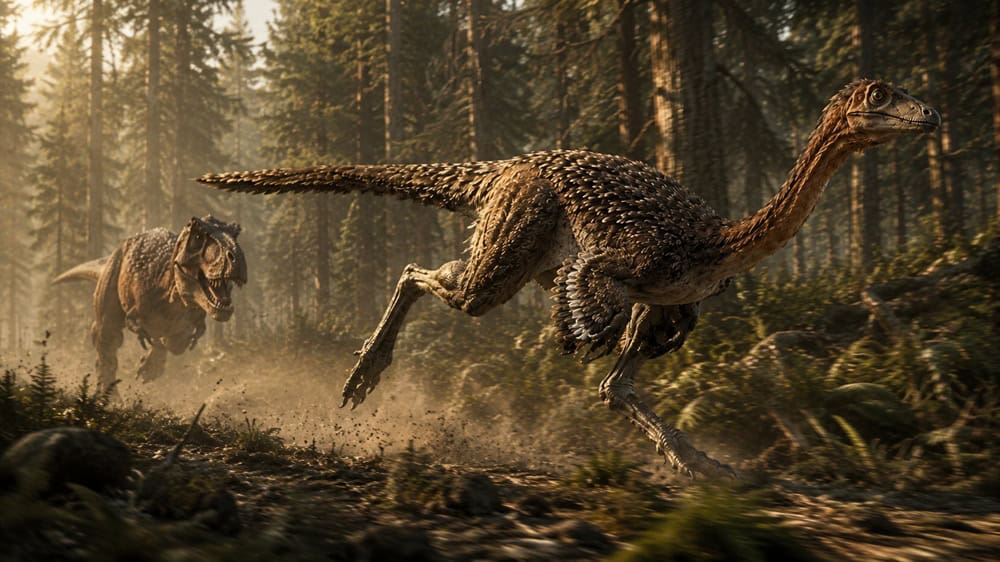
Speed is not a biological luxury — it is a response to a specific environmental pressure. Ornithomimids were relatively defenceless animals. They had no lethal claws, no bony armour, no horns, no tail club. What they did have was the ability to spot a predator at a distance (large eyes with good peripheral vision) and run before it arrived.
This strategy works when the prey animal’s speed consistently exceeds the predator’s. And in the Late Cretaceous, where the main predators were tyrannosaurs (slow but powerful) and dromaeosaurs (agile but not as fast in a straight line), an ornithomimid that could sustain 60 km/h for a few hundred metres had a very good chance of escaping.
At Dinosaurland you can see life-size replicas of several of these speed-demons, including Gallimimus and Compsognathus, and compare their body proportions with those of the great predators that tried to catch them.
Frequently asked questions about the fastest dinosaurs
Which was the fastest dinosaur?
Estimates point to Ornithomimus or Struthiomimus, both ornithomimids, with estimated top speeds between 50 and 80 km/h depending on the method used. In terms of speed relative to body size, Compsognathus also stands out at up to 65 km/h despite weighing less than a kilogram.
Was T. rex fast?
Less so than the films suggest. The most widely accepted estimates place it between 20 and 30 km/h, and some models suggest that the largest adults may not have been able to run at all (meaning they always had at least one foot on the ground). Their hunting strategy probably relied more on ambush than on pursuit.
How is the speed of an extinct dinosaur measured?
Through three main methods: fossil footprints (calculating stride length), biomechanical models (digital simulation of bones and muscles) and anatomical comparison with living animals of similar proportions. No method is exact — all produce speed ranges, not precise figures.
Can I see fast dinosaurs at Dinosaurland?
Yes. At Dinosaurland (Porto Cristo, Mallorca) there are life-size replicas of more than 40 species, including ornithomimids such as Gallimimus, small sprinters like Compsognathus and large predators like T. rex, allowing you to compare their proportions directly.