
When we think of dinosaurs, it is common to imagine giant, terrifying creatures that ruled the Earth millions of years ago. However, the world of dinosaurs is much more diverse than is commonly believed. While some reached colossal sizes, others were surprisingly small.
In this article, we will introduce you to the smallest dinosaurs discovered to date, explaining their characteristics and how their size influenced their behavior and adaptation.
Smallest Dinosaurs: A Miniature Universe!
The record for the world’s smallest dinosaur has changed over time as new discoveries have been made. Currently, some of the tiniest dinosaurs are Compsognathus, Microraptor and the recent Oculudentavis, which was thought to be a very small dinosaur, but was later reclassified as a lizard.
Compsognathus: A Dinosaur the Size of a Rooster
Compsognathus is one of the best known small dinosaurs. It lived during the Late Jurassic, about 150 million years ago, and was about 1 meter long. Its name means “elegant jaw” and it was characterized by an agile and slender body, which allowed it to move quickly to hunt small reptiles and insects.

This dinosaur is one of the most representative in the category of small theropods and has been featured in several documentaries and movies due to its appearance similar to modern birds.
At Dinosaurland you can learn more about the Compsognathus in its fact sheet on our website.
Microraptor: The Little Flyer
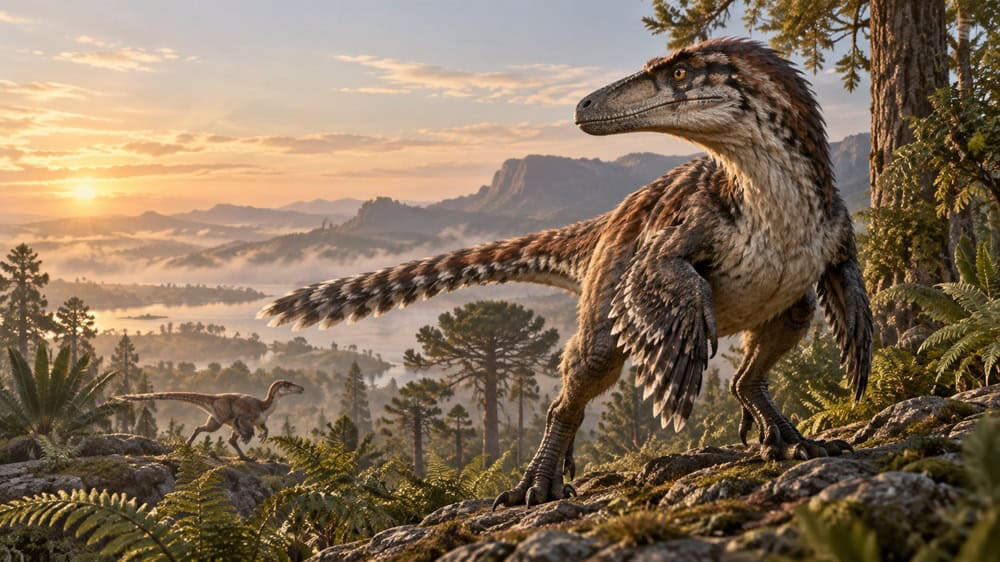
Microraptor is another of the smallest dinosaurs ever discovered, measuring just 77 centimeters long. It lived during the Early Cretaceous, approximately 120 million years ago. This tiny dinosaur is particularly interesting because it had feathers on its front and hind legs, suggesting that it was able to glide between trees.

Its body was covered with feathers, similar to those of a bird, which has led many paleontologists to consider it an early example of the evolutionary transition from dinosaurs to birds. Its small size and flight adaptations allowed it to escape predators and forage in the treetops.
Parvicursor: The Lightest Runner
The Parvicursor, whose name means “little runner,” lived about 85 million years ago in what is now Mongolia. It was a tiny dinosaur that was about 39 centimeters long and weighed about 162 grams, the size of a modern pigeon. Parvicursor was an alvarezsaur, a group of small theropods with unique adaptations, such as specialized claws for digging for insects.

Although its body was very small, Parvicursor was a fast and agile runner, able to move quickly along the ground to escape predators or hunt insects.
The Smallest Dinosaur Debate:Oculudentavis?
In 2020, a small creature was discovered, called the Oculudentavis found in a piece of amber in Myanmar. It was thought that it might be the smallest dinosaur ever discovered, similar in size to a modern hummingbird. However, later studies revealed that Oculudentavis was not a dinosaur, but a very small lizard. This finding, although exciting, demonstrated the complexity of classifying certain species and highlighted how difficult it is sometimes to differentiate between dinosaurs and other reptiles of its time.
Adaptations and Behavior of Small Dinosaurs
Smaller dinosaurs developed various adaptations to survive in their environments. Many had light, agile bodies, which allowed them to move quickly and escape larger predators. Others, such as flying dinosaurs, used their feathers and membranes to glide through trees and forage in areas difficult for large land dinosaurs to reach.
In addition, their small size allowed them to survive in specific ecological niches, such as hunting insects or feeding on small plants. Some also lived in wooded environments, where they could easily hide and escape from predators.
Size Does Not Matter in Prehistory
Although we tend to think of dinosaurs as fearsome giants, smaller dinosaurs also played a crucial role in prehistoric ecosystems. From the agile Compsognathus to the flying Microraptor, these small dinosaurs show the incredible diversity of shapes and sizes that existed in the past. Learning more about them helps us better understand how they evolved and survived in a world dominated by giants.
If you want to learn more about these dinosaurs and others that inhabited the Earth millions of years ago, visit our fact sheets at Dinosaurland and we look forward to exploring the fascinating world of dinosaurs together!