
Imagine an animal so tall it could look through a fourth-floor window without lifting its feet off the ground. That’s what long-necked dinosaurs were like—herbivorous giants that dominated Earth for millions of years.
These titans of the prehistoric world impressed not only with their colossal size but also with a unique evolutionary feature: their extraordinarily long necks that allowed them to reach food where no other animal could.
What are long-necked dinosaurs?
Long-necked dinosaurs, scientifically known as sauropods, were the largest land animals that ever existed. They belonged to the herbivore dinosaurs group and lived mainly during the Jurassic and Cretaceous periods, between 200 and 66 million years ago.
Their anatomy was so perfect for their lifestyle that they dominated virtually all terrestrial ecosystems on the planet for over 140 million years. To put this in perspective, modern humans have been on Earth for just 300,000 years.
Main characteristics of sauropods
These giants shared unique traits that made them unmistakable:
- Extremely long neck: between 9 and 15 meters depending on the species
- Massive body: some weighed over 70 tons
- Herbivorous diet: consumed between 200 and 400 kg of vegetation daily
- Hollow vertebrae: lightweight structure that supported the neck’s weight
- Long, heavy tail: acted as a counterweight to the neck
The evolutionary secret of the long neck
The evolution of the elongated neck in these dinosaurs was one of the most successful adaptations in the history of life on Earth. These creatures developed hollow, lightweight vertebrae that allowed them to support necks up to 15 meters long without collapsing under their own weight.
This revolutionary bone structure worked like the pillars of a suspension bridge, combining strength with lightness in a way that modern engineers still study with admiration.
Competitive advantages of the long neck
But the long neck wasn’t just about reaching treetops. This feature gave them multiple advantages in their habitat:
- Energy efficiency: They could feed on vegetation at different heights without needing to move constantly, which saved an enormous amount of energy considering some weighed over 70 tons.
- Greater feeding radius: They explored a much larger area than any other herbivore simply by turning their neck from side to side while staying in the same spot.
- Exclusive access to resources: They reached leaves and shoots in tall treetops where there was no competition with other herbivores.
Sauropods could consume the equivalent of 200-400 kg of vegetation daily, approximately the weight of three adult people in plant food every day.
The most impressive giants
 Brachiosaurus: the long-armed giant
 Brachiosaurus: the long-armed giant
Brachiosaurus is one of the most famous and iconic long-necked dinosaurs from the Late Jurassic. This colossus measured approximately 25 meters long and weighed between 30 and 60 tons, equivalent to the weight of eight adult African elephants.
What made Brachiosaurus unique was the position of its front legs, longer than the hind ones, which gave it a posture similar to a modern giraffe. It could raise its head up to 13 meters high, like a four-story building.
It lived about 154 to 153 million years ago in what we now know as North America and Africa, feeding mainly on conifers and other tall plants.
Diplodocus: the prehistoric whip
Diplodocus stood out not so much for its height as for its exceptional length. This herbivorous long-necked dinosaur could reach up to 27 meters long, with its extremely long tail being the most striking feature.
With more than 80 vertebrae in its tail, scientists believe it probably used it as a defensive whip against predators. Unlike Brachiosaurus, Diplodocus kept its neck in a more horizontal position and fed on low and medium vegetation.
It stripped leaves from ferns and herbaceous plants growing near the ground, using its neck like a telescopic arm that swept wide areas without moving its enormous body.
Argentinosaurus: the absolute titan
Argentinosaurus, discovered in Argentina in 1987, holds the title of one of the largest dinosaurs ever found. With estimates suggesting a weight of up to 100 tons and a length of 30 to 35 meters, this Late Cretaceous titanosaur represents the upper limit of what physics allows in a land animal.
A single femur bone measured over two meters tall, taller than an average adult person. Despite its colossal size, it was completely herbivorous and spent most of the day feeding to maintain its gigantic body mass.
The three giants
| Dinosaur | Period | Length | Weight | Head height | Unique feature |
|---|---|---|---|---|---|
| Brachiosaurus | Late Jurassic (154-153 Mya) | 25 meters | 30-60 tons | 13 meters | Longer front legs |
| Diplodocus | Late Jurassic (155-145 Mya) | 27 meters | 15-20 tons | 6 meters | Tail with 80+ vertebrae |
| Argentinosaurus | Late Cretaceous (97-93 Mya) | 30-35 meters | 80-100 tons | 12 meters | Heaviest known |

Perfect anatomy for giant herbivores
The relationship between the long neck and the herbivorous diet of these dinosaurs was much more complex than it appears. Their digestive system was specially adapted to process huge amounts of plant matter.
Many sauropods had peg-shaped or spatula-shaped teeth, designed not for chewing but for stripping and swallowing vegetation. They then processed the food in a stomach equipped with powerful gastric juices and, possibly, gastroliths that helped grind the food like an internal mill.

The elongated neck also directly influenced their feeding strategy. While short-necked herbivores had to move constantly to find new feeding areas, sauropods could remain relatively static.
They simply moved their neck in a wide arc, accessing tons of vegetation without spending the tremendous energy required to move their massive bodies. This advantage was especially important during dry seasons or in ecosystems where vegetation was scarce.
The vital role in prehistoric ecosystems
Long-necked dinosaurs weren’t passive consumers of vegetation, but true architects of their ecosystems. By feeding on treetops and tall vegetation, they controlled the vertical growth of forests.
This allowed sunlight to reach lower levels and favor the growth of low plants that fed other smaller herbivores. In this way, they created and maintained a diversity of ecological niches that benefited the entire food chain.
Engineers of the prehistoric landscape
Their impact on the landscape was comparable to modern elephants in African savannas. When herds of sauropods moved through an area, their colossal weight:
- Compacted the soil and created trails that other animals used
- Knocked down trees that opened clearings in the forest
- Generated diverse habitat mosaics that increased biodiversity
- Fertilized the soil with their monumental droppings
- Dispersed seeds over large distances
They acted as prehistoric gardeners who constantly shaped the plant landscape.
Behavior and social life
Although for a long time it was thought these giants were solitary creatures, discoveries of fossilized tracks and communal nests suggest that many sauropod species lived and moved in groups.

This gregarious behavior provided them protection against large theropod predators like Allosaurus or Tyrannosaurus rex. A group of enormous adults represented a formidable barrier, with young and more vulnerable individuals traveling protected in the center of the herd.
Prolonged parental care
It’s believed these dinosaurs also cared for their young for extended periods, a significant parental investment that partly explains their evolutionary success.
Young were born from eggs surprisingly small compared to adult size, approximately the size of a soccer ball. They had to grow for decades to reach their final size.
This long growth period required parental care and group protection, a strategy that, though costly in terms of resources, ensured enough individuals reached adulthood to maintain the population.
Discover long-necked dinosaurs at Dinosaurland
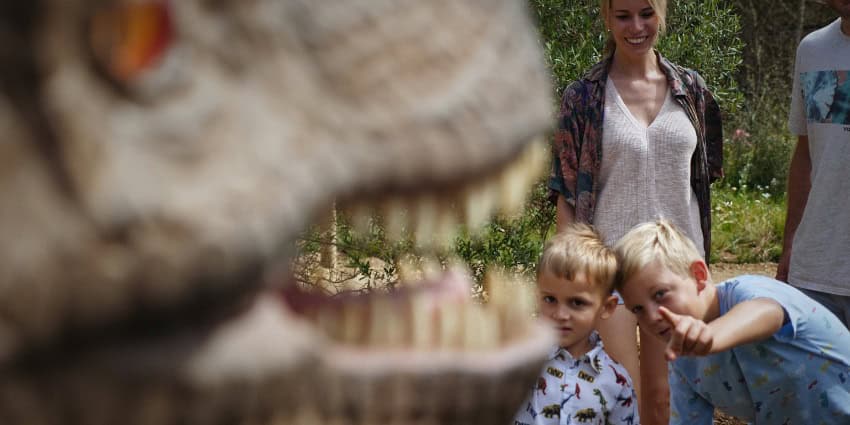
If you want to see these giants at real size and learn more about their fascinating world, we invite you to visit Dinosaurland in Porto Cristo, Mallorca. The park features impressive replicas of Brachiosaurus, Diplodocus, and many other sauropods that will let you compare your size with these prehistoric titans.
Frequently asked questions about long-necked dinosaurs

When did long-necked dinosaurs live?
Sauropods or long-necked dinosaurs lived mainly during the Jurassic and Cretaceous periods, between 200 and 66 million years ago. Their time of greatest diversity and abundance was during the Late Jurassic, about 150 million years ago, when species like Brachiosaurus and Diplodocus dominated terrestrial ecosystems. These herbivorous giants became extinct along with all non-avian dinosaurs 66 million years ago, at the end of the Cretaceous period, probably due to a massive asteroid impact and resulting climate changes.
How big were the largest long-necked dinosaurs?
The largest known sauropods, like Argentinosaurus, reached lengths of 30 to 35 meters and weighed approximately 100 tons, equivalent to the combined weight of fourteen adult African elephants. Brachiosaurus measured about 25 meters long and could raise its head up to 13 meters high, comparable to a four-story building. Their necks alone could measure between 9 and 15 meters in length, depending on the species. To put these dimensions in perspective, if you placed an Argentinosaurus next to a soccer field, it would occupy approximately one-third of its total length.
What did herbivorous long-necked dinosaurs eat?
Sauropods fed exclusively on plants, consuming mainly conifers, ferns, cycads, and other Mesozoic plants. An adult individual needed to consume between 200 and 400 kilograms of vegetation daily to maintain its gigantic body mass. Unlike modern herbivores that chew their food, sauropods used peg-shaped teeth to strip leaves and branches that they swallowed whole. Their digestive system processed this plant matter with the help of powerful gastric juices and gastroliths, stones they intentionally swallowed that functioned as an internal mill grinding the food in their stomach.
Why did long-necked dinosaurs have such long necks?
The long neck gave them multiple evolutionary advantages for their survival. Primarily, it allowed them to reach vegetation in treetops where there was no competition with other herbivores, accessing exclusive food sources. Additionally, they could explore a wide feeding radius without needing to constantly move their massive body, which saved enormous amounts of energy. This efficiency was crucial considering some weighed over 70 tons. Their neck functioned like a telescopic arm that could sweep extensive areas of vegetation simply by turning from side to side, maximizing food intake with minimum energy expenditure.
Can you see long-necked dinosaurs at Dinosaurland?
At Dinosaurland you can find life-size replicas of several long-necked dinosaurs, including the impressive Brachiosaurus, one of the favorites among families visiting us. The park has over 100 dinosaur replicas distributed along a 2 to 3-hour route where you can compare your size with these prehistoric giants and learn about their fascinating biology. Additionally, our information plaques explain verified scientific data about each species, and our team is always available to answer questions and make your visit educational and memorable. The park is located in Porto Cristo, Mallorca, and is ideal for the whole family.