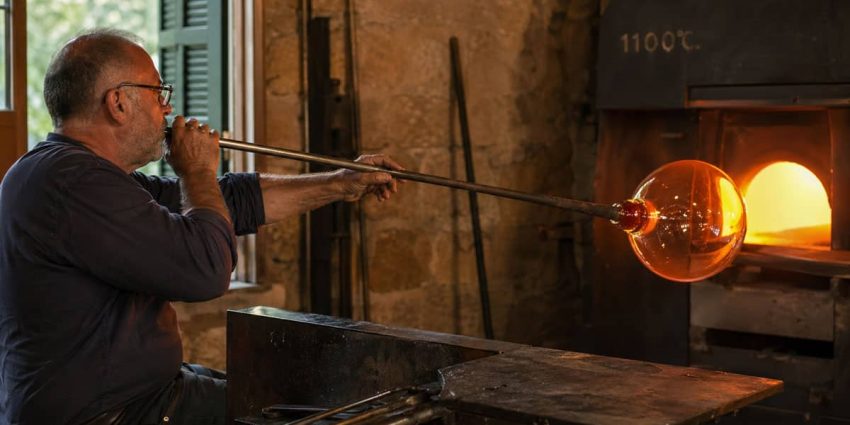
Mallorca has had a relationship with blown glass that dates back to the early eighteenth century. What started as a small kiln authorised by Palma’s town council in 1719 has become an artisan tradition that is still alive three centuries later, with workshops where master glassblowers work in front of the fire in exactly the same way their forebears did.
This is no museum piece. Mallorca’s glass factories are still producing items every day. You can visit them, and in some you can watch the entire process: from the glowing mass at 1,100 °C to the finished object in the craftsman’s hands. It is one of those experiences that rarely appears in conventional guidebooks but that stays with you.
If you are planning a trip to the island and are looking for something beyond beaches and hiking trails, the glass factories are a stop well worth making.
The history of blown glass in Mallorca
It all begins in 1719, when a young glassblower named Blas Rigal, originally from the Crown of Aragon, settled in Mallorca and applied to Palma’s town council for permission to build a glass kiln. The licence was granted by Don Gaspar de Puigdorfila, and the venture was financed by a Catalan-Aragonese merchant by the name of Gordiola.
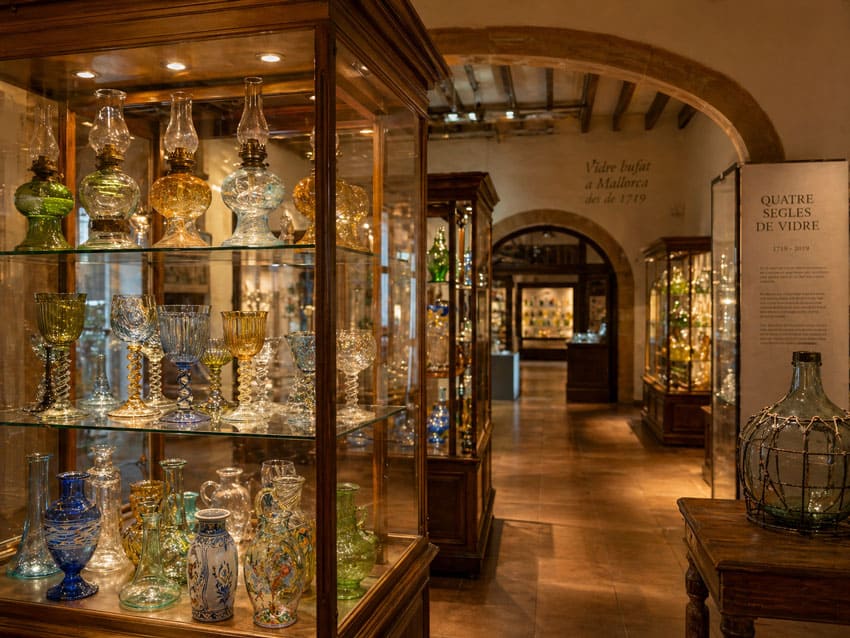
That is how the Gordiola dynasty was born — a family that over more than 300 years and eight generations has kept the craft of blown glass alive on the island. It is the oldest glass factory in Mallorca and one of the oldest in Spain still in continuous operation.
For its first two centuries the factory stood in Palma. In 1973 it moved to the outskirts of Algaida, where the workshop, shop and Glass Museum are located today. The move made it possible to expand the premises and open the process up to the public.
Meanwhile, in 1964 the Tortella family founded Lafiore, another blown-glass factory that has taken a different path: blending traditional technique with contemporary design. While Gordiola keeps a more classical profile, Lafiore works with recycled glass and more modern product lines.
Both represent two sides of the same tradition: respect for an age-old technique and the ability to adapt to the present.
Gordiola: three centuries of fire and glass
The Vidrios de Arte Gordiola factory sits on the Palma–Manacor road at kilometre 19, in the municipality of Algaida. It is open to visitors from Monday to Saturday, and admission to the workshop and museum is free.
What makes the visit special is that you can watch the artisans at work in real time. The master glassblowers stand in front of furnaces reaching 1,100 °C, gather a blob of molten glass on the end of a metal blowpipe and shape it by blowing and turning, using tools that have barely changed in centuries.
Every piece is made by hand, and it shows. The slight irregularities, the tiny air bubbles trapped inside, the particular lustre of hand-blown glass — all of these are hallmarks, not flaws. On the base of each piece you can see the pontil mark, left where the blowpipe was separated from the object. Gordiola’s glassblowers call it the “navel” of the piece.
The Glass Museum occupies the upper floor and displays pieces from Gordiola’s historical output alongside glass from other centres around the world. It is small but well kept, and it helps you understand how the craft has evolved over the centuries.
Gordiola has been producing blown glass in Mallorca since 1719. It is the island’s oldest glass factory, with over 300 years of history and eight generations of the same family at the helm. Admission to the workshop and museum is free.
Lafiore: tradition meets contemporary design
The Lafiore factory is in S’Esgleieta, a small village between Palma and Valldemossa. Founded in 1964, it has always pursued a line that marries blown-glass technique with a more up-to-date design sensibility.
One of the features that sets Lafiore apart is its use of recycled glass. Much of the raw material comes from recovered containers, which are melted down and transformed into new pieces. The process adds a sustainability element without compromising the quality of the final product.
Its catalogue ranges from the classic Mallorcan oil cruets — a functional object that has become an emblem of the island — to vases, goblets, lamps and decorative items with clean lines and vibrant colours.
A visit to Lafiore includes the chance to see the workshop in action and a showroom-shop displaying the full collection. The space itself is curated with an eye for aesthetics that fits the brand’s philosophy.
What is blown glass and how is it made?
For anyone who has never seen the process, there is something mesmerising about glassblowing. The basic procedure has not changed substantially since antiquity:
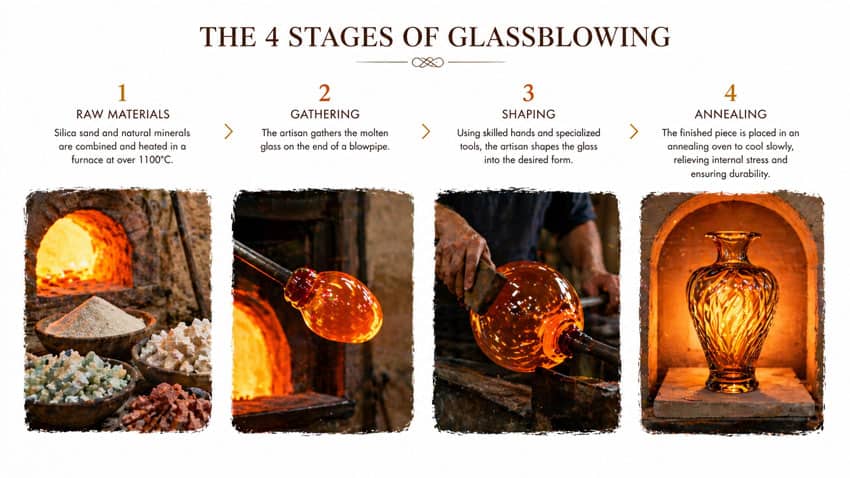
- Melting. Silica sand, mixed with fluxes such as sodium carbonate and lime, is melted in a furnace at temperatures above 1,100 °C until it becomes a viscous, glowing mass.
- Gathering. The artisan dips a hollow metal blowpipe into the furnace and collects a portion of molten glass on the tip. The mass glows an intense orange.
- Blowing and shaping. By blowing through the opposite end of the pipe, the glassblower creates a bubble inside the mass. Then, combining blowing with rotation, tongs and moulds, the object takes shape. Gravity and temperature are allies and enemies at the same time — you have to work fast before the glass cools and loses its malleability.
- Annealing Once the piece is finished, it goes into an annealing oven that cools it slowly over several hours. Cooling too quickly would create internal stresses that would cause the glass to crack.
The entire process, from gathering to the final cut, takes only a few minutes for small pieces. But those minutes condense years of training.
Practical information for your visit
Gordiola (Algaida):
- Address: Ctra. Palma–Manacor, km 19. Algaida.
- Opening hours: Monday to Saturday, 9:00–18:00 (summer) / 9:00–17:00 (winter). Closed Sundays.
- Admission: free (workshop + museum + shop).
- Estimated visit time: 45–60 minutes.
- From Porto Cristo: about 40 minutes by car.
Lafiore (S’Esgleieta):
- Address: Ctra. Esporles, s/n. S’Esgleieta (Esporles).
- Opening hours: Monday to Friday, 10:00–17:00. Saturdays 10:00–14:00.
- Admission: free.
- Estimated visit time: 30–45 minutes.
- From Porto Cristo: about 55 minutes by car.
Both factories are accessible and suitable for visiting with children, although it is wise to keep a safe distance from the furnaces. They make a great plan to combine with other cultural visits on the island.
If you are interested in exploring Mallorca’s cultural offering beyond the beaches, we recommend our article on a tour of the island’s museums, where you will find everything from contemporary art to local history.
Frequently asked questions about glass factories in Mallorca
Which is the oldest glass factory in Mallorca?
Gordiola, founded in 1719 in Palma and currently located in Algaida. It has been in operation for over 300 years, with eight generations of the Aldeguer-Gordiola family at the helm. It is one of the oldest hand-blown glass factories in Spain.
Can you watch blown glass being made?
Yes. At both Gordiola and Lafiore you can watch the artisans working in real time during visiting hours. The full process — melting, blowing, shaping — is visible from the public viewing area. No advance booking is needed.
What is the difference between Gordiola and Lafiore?
Gordiola keeps a more classical and traditional profile, with pieces that follow the factory’s historical designs. Lafiore takes a contemporary approach, working with recycled glass and modern design lines. Both use the hand-blowing technique, but the aesthetic result is different.
Is it a good visit for children?
Yes. Most children are fascinated by watching a glowing mass turn into a recognisable object in a matter of minutes. It is a highly visual experience. Just make sure they keep a safe distance from the furnaces and supervise them around the pieces in the shop.