
When we think of dinosaurs, perhaps we imagine landscapes of North America, Africa or Asia… but the truth is that Spain was a land of dinosaurs. From the mountains of Teruel to the coast of Asturias, the Spanish territory holds a fossil treasure of incalculable value.
In this article we take you on a tour of dinosaur sites in Spain, we tell you what species have been discovered, where you can see fossils, real footprints and life-size replicas, and why our country is one of the paleontological references in Europe. Ready for this Jurassic journey?
Dinosaur sites in Spain
| 🧭 Area | 🦴 Deposits | 🔍 What was found | 👀 What you can see today |
|---|---|---|---|
| La Rioja | Enciso, Igea, Arnedillo | Footprints (ichnites) | Signposted routes, interpretation centers |
| Basin | Las Hoyas, Lo Hueco | Fossils, skeletons | Paleontological Museum (MUPA), guided tours |
| Teruel | Galve, Riodeva | Unique fossils, footprints | Dinópolis + satellite museums |
| Asturias | Colunga, Ribadesella, Lastres | Ichnites in coastal rocks | MUJA Museum + routes of the “Dinosaur Coast”. |
| Burgos | Salas de los Infantes | Remains of several species | Dinosaur Museum of Salas de los Infantes |
| Castellón | Morella | Ornithopod fossils | Exhibition “Temps de Dinosaures” in the local museum |
What dinosaur species have been discovered in Spain?
Spain has been a veritable laboratory of the past. These are some of the most outstanding species:
Concavenator corcovatus (Cuenca)
Nicknamed “the humpbacked hunter”, this carnivorous theropod from the Cretaceous had a strange dorsal protuberance. Its discovery in Las Hoyas made it one of the best known European dinosaurs.
Aragosaurus ischiaticus (Teruel)
It was the first dinosaur scientifically described in Spain, in 1987. A large herbivorous sauropod that lived 130 million years ago.
Iguanodon galvensis (Teruel)
A robust dinosaur that lived in a group. Its discovery at Galve revealed much about the European herbivores of the Lower Cretaceous. Learn more about Iguanodon.
Demandasaurus darwini (Burgos)
A long-necked sauropod with evolutionary links to Africa. It was discovered in the area of the Sierra de la Demanda.
Lirainosaurus astibiae (La Rioja)
A medium-sized titanosaur that lived near fluvial environments. It is one of the few titanosaurs identified in northern Spain.
Qinkasaura pintiquiniestra (Cuenca)
Discovered in 2024 in the works of the AVE, this giant titanosaur, more than 20 meters long, lived about 70 million years ago. Its discovery made national news due to its exceptional state of preservation(source).
Where to see dinosaur tracks and fossils today?

La Rioja: between mountains and real footprints
With more than 3,000 ichnites distributed in villages such as Enciso, Igea and Arnedillo, this area offers marked routes to literally walk on dinosaur footprints. You can visit the Enciso Paleontological Center and learn about the species that lived there.
Basin: land of the Concavenator
The sites of Las Hoyas and Lo Hueco are some of the most important in Europe. If you visit the Paleontological Museum of Castilla-La Mancha (MUPA) you can see real fossils and impressive replicas.
Teruel: Dinópolis and much more
In addition to the Dinópolis theme park, in Teruel there are small museums scattered in municipalities such as Galve or Riodeva. An ideal experience for families.
Asturias: the Coast of Dinosaurs
On beaches such as La Griega, Merón or Tereñes, you can see fossilized footprints in the rocks of the coastline. Don’t miss the MUJA, one of the most complete dinosaur museums in Europe.
Want to go deeper?
If you liked this tour of Spanish dinosaurs, don’t miss our article on Where to find real dinosaur fossils in Spain, with practical tips for visiting them with your family.
Jurassic curiosities you didn’t know about
- The first dinosaur described in Spain was Aragosaurus, and that was in 1987!
- On the coast of Colunga (Asturias), footprints of more than 1 meter in diameter have been preserved.
- In Enciso (La Rioja) you can follow the “Path of the Dinosaurs” and see more than 1,400 footprints in only 5 km.
What if you are in Mallorca?
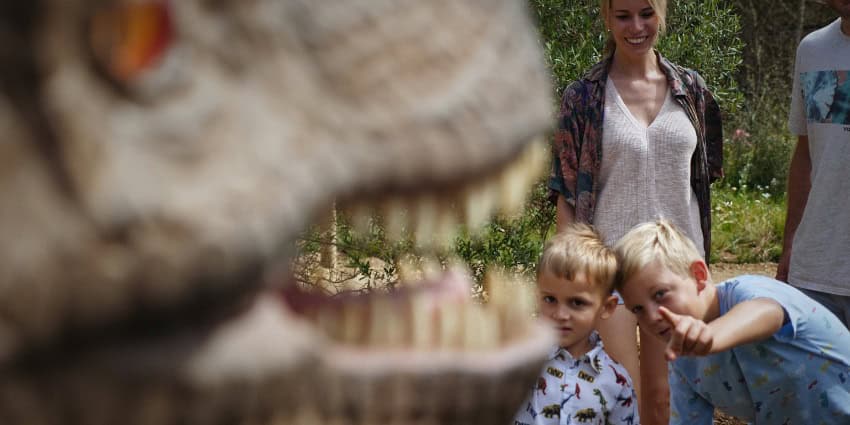
Although no dinosaur fossils have been found on the island, in Dinosaurland you can live the most realistic experience without the need for excavations. More than 100 life-size dinosaurs, interactive areas and shows await you in our park in Porto Cristo. A must if you are traveling with children (or if you love prehistory as much as we do!).

Spain is a gold mine for dinosaur lovers. Whether walking among footprints on the Asturian coast or visiting museums in Cuenca, our country preserves a unique legacy that connects us with a past more than 65 million years old.
And if you are in Mallorca, Dinosaurland opens the doors to a Jurassic world without leaving the island. Because here dinosaurs… have never been extinct.