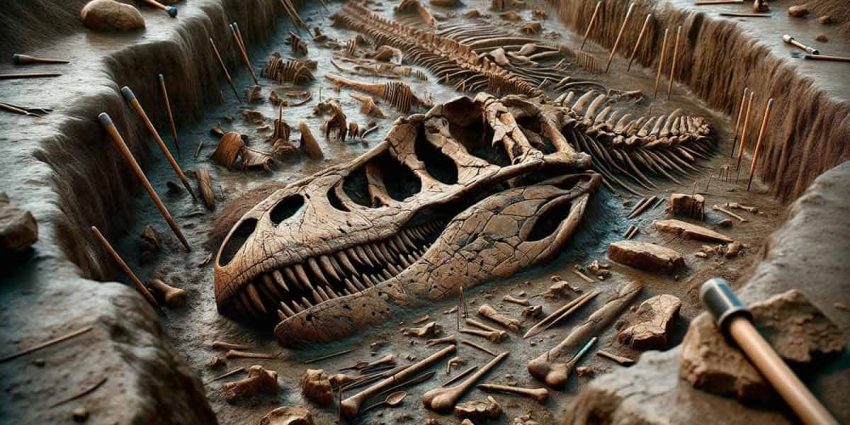
Dinosaur fossils are true treasures from the past that connect us to a fascinating prehistoric world. Spain, rich in history and geology, has witnessed numerous discoveries over the years. From the arid plains of Teruel to the coasts of Asturias, Spain is home to a wide variety of fossils, including some dinosaurs that once roamed the earth millions of years ago.
Índice
ToggleA Glimpse into Spain’s Paleontological History
The history of paleontology in Spain dates back centuries. However, significant fossil discoveries began to gain prominence in the 19th century. One of the most notable finds was the discovery of the remains of the Iguanodon in 1884 by Belgian paleontologist Louis Dollo in the province of Teruel.
Throughout the 20th century, numerous discoveries were made in different regions of Spain, revealing a surprising wealth of paleontological treasures. Of particular note are the sites in the Tremp Basin in Catalonia, and the areas of Enciso (La Rioja) and Galve in Teruel, where dinosaur remains and other fossils dating back to the Cretaceous Period have been found.
Teruel: The Mecca of Dinosaurs in Spain
Teruel stands as one of the most important epicenters for the study of dinosaurs in Spain and internationally. Its paleontological wealth has captured the attention of scientists, researchers, and enthusiasts from around the world due to the diversity and quality of the fossils it houses.
The Teruel Basin, located in the province of the same name in the autonomous community of Aragon, is a true prehistoric treasure. This vast region has been the site of numerous discoveries of dinosaur fossils dating back to the Cretaceous Period.
It is home to several emblematic sites that have provided valuable information about the life of dinosaurs in the region. The most notable are:
- Galve. This small town in Teruel is known for its exceptional paleontological site. Fossil remains of dinosaurs such as the sauropod Turiasaurus riodevensis, one of the largest found in Europe, have been discovered in Galve.
- Riodeva. Another important site in Teruel, where dinosaur fossils, including sauropods and theropods, have been discovered. This site has provided valuable information on the diversity and evolution of dinosaurs in the region.
- Mirambel. Located in the foothills of the Palomita mountain range, it is known for its footprints dating back to the Cretaceous period, revealing details about the behavior and ecology of the dinosaurs that once inhabited the region.
Teruel strives to preserve and protect its paleontological heritage. Conservation and site management measures have been established to ensure that the fossils are properly studied and protected.
Burgos: Paleontological Wealth in Northern Spain
Burgos, located in the region of Castilla y León, is renowned for its remarkable paleontological wealth, spanning from prehistory to more recent times. This northern Spanish province has witnessed important discoveries, especially regarding fossils of dinosaurs and other prehistoric organisms.
The region of La Demanda, in the province of Burgos, is one of the main centers of Paleolithic interest in the region. This mountainous area has revealed a variety of fossils dating from diverse geological periods, from the Jurassic to the Cretaceous. Notable sites such as Salas de los Infantes and Soria have provided important fossil sites, providing evidence of the presence of herbivorous and carnivorous dinosaurs, among other organisms.
Asturias: Fossils on the Northern Coasts
The coasts of Asturias, bathed by the Cantabrian Sea, have also revealed paleontological secrets. In places like Villaviciosa and Lastres, fossils of dinosaurs and other marine organisms dating back to the Jurassic period have been discovered. These discoveries have provided invaluable information about the evolution of the species and ancient ecosystems that once dominated the region.
Dinosaur fossils in Spain are not only a window to the past but also a source of inspiration and knowledge about the history of our planet. From majestic sauropods to ferocious theropods, each discovery brings us a little closer to understanding the extraordinary diversity of life that existed millions of years ago.
Through the dedication of paleontologists and scientists, Spain continues to be a prime destination for the exploration and discovery of real dinosaur fossils, reminding us of the importance of preserving our heritage for future generations.