For the 165 million years that the age of the dinosaurs lasted, terrestrial ecosystems ran on a logic not so different from today’s: there were herbivores that fed on plants, and there were predators that fed on those herbivores. The carnivores of the Mesozoic were not simply “dinosaurs that ate meat”. They were specialised biological machines, equipped with very specific anatomical adaptations to locate, pursue, capture and process their prey.
Some hunted alone, relying on sheer size and brute force. Others did so in groups, using coordinated strategies. And some did not hunt at all: they fed on carrion, eggs or small prey that required no lengthy chase.
Understanding how Mesozoic carnivores fed means understanding how entire ecosystems of that era worked. Because predators, then as now, are the ones that regulate the balance.
What defines a carnivorous dinosaur
All known carnivorous dinosaurs belong to the theropod group: bipedal dinosaurs with powerful hind limbs and, in most cases, shorter forelimbs. But within the theropods the diversity is enormous. A Tyrannosaurus rex measuring 12 metres and weighing 8 tonnes is a very different animal from a Compsognathus the size of a chicken.
What all carnivores share are certain anatomical adaptations linked to predation:
- Curved, serrated teeth. Unlike the flat teeth of herbivores, carnivore teeth were designed to tear muscle tissue. The serrated edges worked like a saw, slicing through flesh on contact.
- Binocular vision. Many carnivores had forward-facing eyes, giving them depth perception — a decisive advantage when judging the distance to a moving target.
- Curved claws. On the forelimbs and, in some cases, on the hind limbs as well (such as the famous retractable claw of the Velociraptor), claws served to grip, tear or wound prey.
- Proportionally large brain. Compared with herbivores of similar size, many carnivores had more developed brains, especially the areas linked to smell and motor coordination.
These adaptations did not appear overnight. According to a study featured in National Geographic, the earliest dinosaurs already included species with carnivorous diets, and it was that capacity for dietary specialisation that partly explains their evolutionary success.
The apex predators: brute force and lethal jaws
At the top of the Cretaceous food chain stood the tyrannosaurs and the carcharodontosaurs: large-bodied predators that relied on the power of their bite to bring down prey.
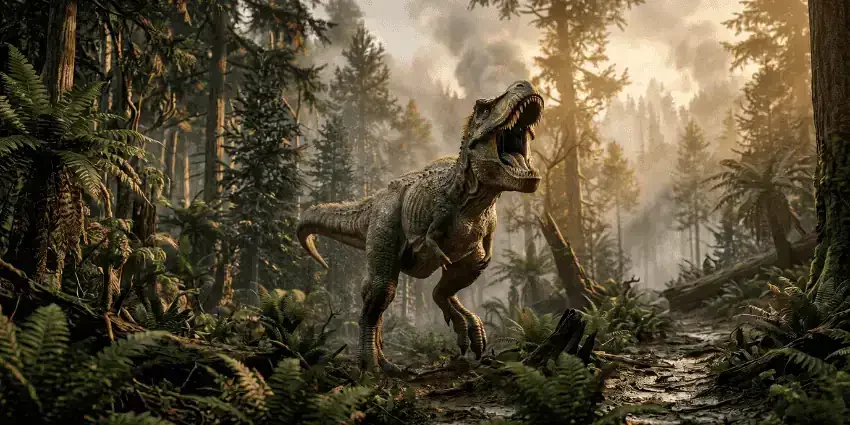
The Tyrannosaurus rex is the best known, and rightly so. With an estimated bite force of over 5,800 kilograms — the most powerful of any known land animal — it could crush the bones of large herbivores such as Triceratops and Edmontosaurus. Its teeth, thick and conical, were not designed to cut with precision but to crush and rip away entire chunks of flesh and bone.
The carcharodontosaurs, such as Giganotosaurus from Cretaceous South America, were even longer than the T. rex (up to 13 metres), though with a less powerful bite. Their thinner, sharper teeth were better suited to slicing than crushing — a different strategy for different prey.
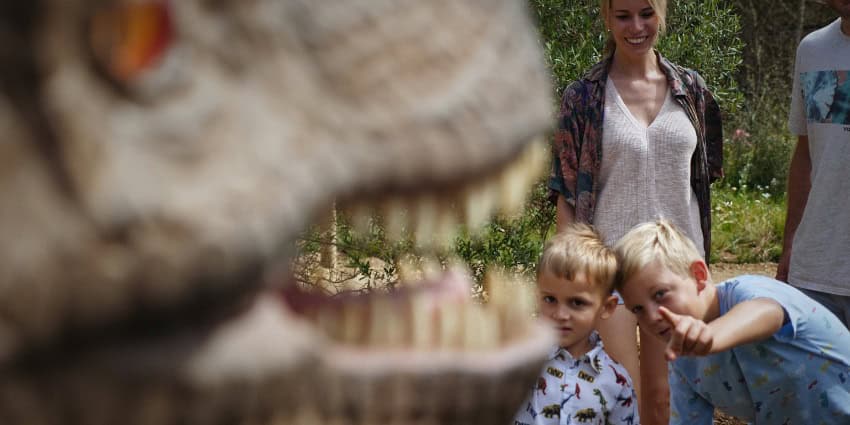
At Dinosaurland you can see life-sized replicas of both the Tyrannosaurus rex and other large theropods, which gives you a real sense of the scale of these predators.
The agile hunters: speed, claws and intelligence
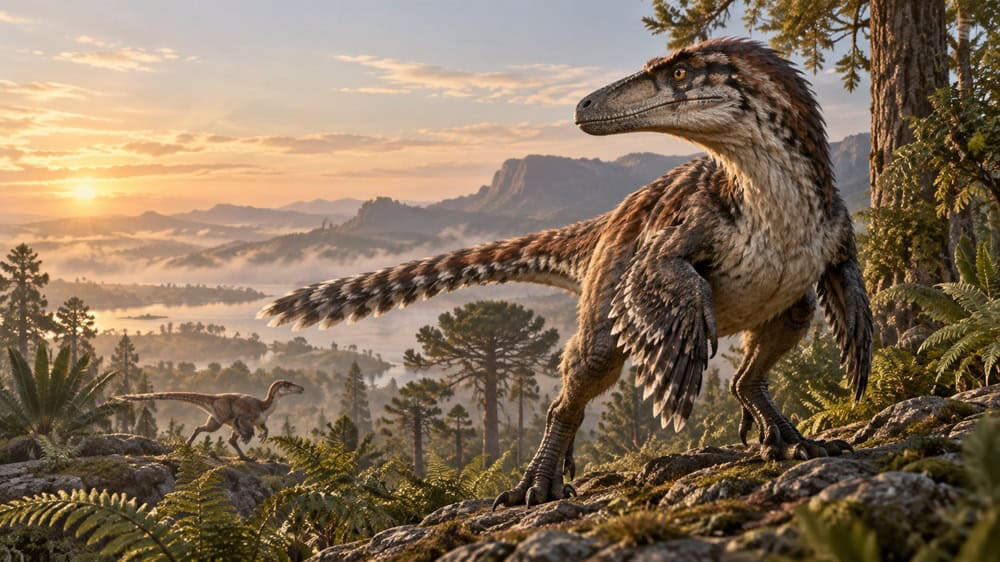
Not all carnivores relied on size. The dromaeosaurs (the family that includes Velociraptor and Deinonychus) were medium-sized predators that made up for their smaller build with speed, agility and, possibly, pack hunting.
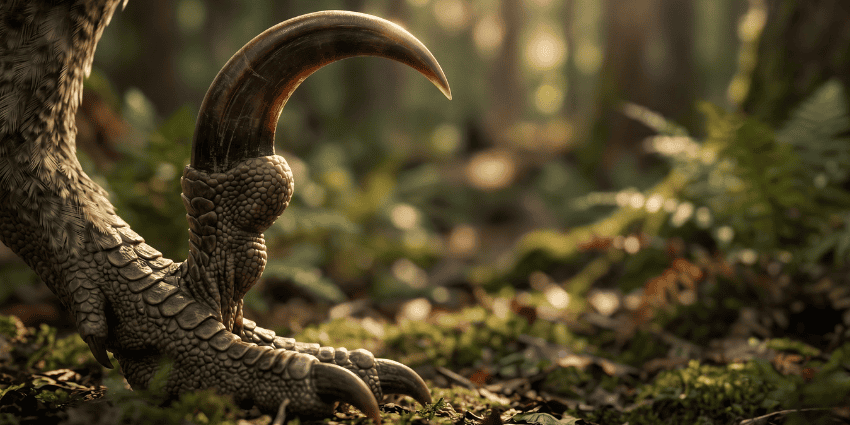
Deinonychus, which measured about 3.4 metres long and weighed around 70 kilograms, had a sickle-shaped retractable claw on each hind foot. This claw was not for running: it was held off the ground while sprinting and deployed to stab and tear on contact with prey. Some palaeontologists suggest the claw functioned more to pin the prey down than to cut it, similar to the way modern birds of prey hunt.
Velociraptor, smaller than the films suggest (about 60 cm tall and 15–20 kg), probably hunted prey its own size or smaller. The discovery of the famous “fighting dinosaurs” fossil in Mongolia, in which a Velociraptor and a Protoceratops were preserved locked in combat, is one of the most direct pieces of evidence of how these animals hunted.
The retractable claw of Deinonychus did not touch the ground when walking. It was held raised to keep its edge sharp and was only deployed during an attack, functioning as a gripping tool similar to the talons of a modern eagle.
The specialists: unusual diets among carnivores
Not all carnivorous theropods fed on other dinosaurs. Some developed highly specific dietary niches:
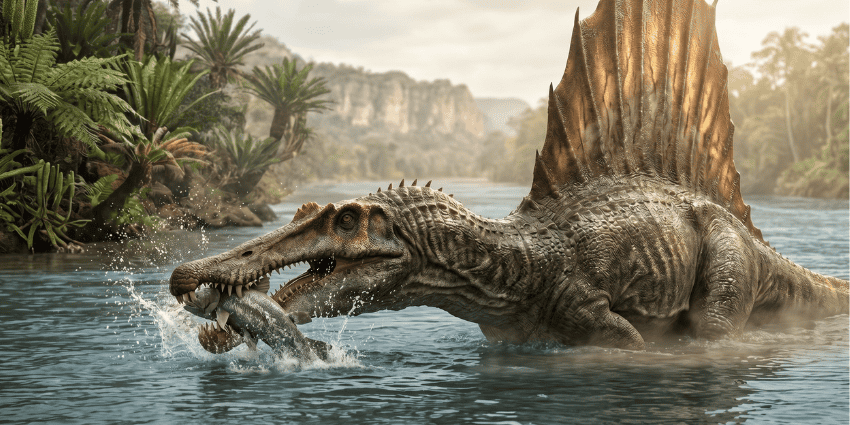
- Spinosaurs. The Spinosaurus group, with their elongated snouts and conical teeth lacking serrated edges, fed primarily on fish. Their anatomy resembles a crocodile’s more than that of a classic terrestrial predator.
- Oviraptors. Despite a name meaning “egg thief”, recent studies suggest that Oviraptor had a more varied diet that included molluscs, small vertebrates and insects. Its toothless beak was adapted for crushing, not tearing.
- Compsognathus. One of the smallest known carnivorous dinosaurs (about the size of a rooster), it fed on lizards, insects and small mammals. Fossils found with stomach contents confirm that lizards were a regular part of its diet.
This diversity of feeding strategies is what allowed multiple carnivore species to coexist in the same ecosystem without competing directly for the same resources.
How we know what they ate: the fossil evidence
Palaeontologists cannot watch a dinosaur hunt. But they have tools to reconstruct diets with considerable accuracy:
- Fossilised stomach contents. In exceptional cases, fossils have been found with remains of the last meal still inside the abdominal area.
- Coprolites. Fossilised droppings contain fragments of bone, scales or plant fibre that reveal what the animal ingested.
- Bite marks on bones. Herbivore bones bearing tooth marks make it possible to identify which predator attacked, by cross-referencing the shape of the marks with the known dentition of each species.
- Dental morphology. Tooth shape is the most reliable indicator: serrated teeth for meat, flat teeth for vegetation, conical teeth for fish.
Every new fossil adds information to this puzzle. And every discovery confirms that the diets of Mesozoic carnivores were as diverse and specialised as those of today’s predators.
If you want to learn more about how dinosaurs are classified by diet, we recommend our article on omnivorous, carnivorous and herbivorous dinosaurs of the prehistoric world, where we analyse each group in detail.
Frequently asked questions about carnivorous dinosaurs
Which was the largest carnivorous dinosaur?
In terms of length, Spinosaurus could reach 15–16 metres, although its diet was mainly fish-based. Among pure land predators, Giganotosaurus (up to 13 metres) and Tyrannosaurus rex (up to 12.3 metres) are the largest known.
Did all carnivorous dinosaurs actively hunt?
No. Some were opportunistic scavengers that fed on animals already dead, and others combined active hunting with scavenging depending on availability. Even the T. rex, considered the apex predator of the Cretaceous, probably scavenged when the opportunity arose.
Did carnivorous dinosaurs hunt in packs?
There is evidence suggesting this for some dromaeosaurs such as Deinonychus, based on multiple individuals found alongside the remains of a single prey animal. However, the debate remains open: not all palaeontologists accept that this implies coordinated hunting rather than simply gregarious feeding.
Where can I see life-sized carnivorous dinosaurs?
At Dinosaurland (Porto Cristo, Mallorca) you can see life-sized replicas of more than 40 species, including theropods such as Tyrannosaurus rex, Velociraptor, Deinonychus, Oviraptor and Compsognathus. Each figure includes information about the species, its diet and its habitat.