
Imagine an animal capable of crushing its prey’s bones with a force equivalent to the weight of three compact cars dropping onto a single point. That was the bite of the Tyrannosaurus rex — but was it really the strongest dinosaur in history? The answer isn’t as straightforward as it seems, because strength in the prehistoric world took very different forms and the biggest didn’t always win.
Strength in the world of dinosaurs: more than just muscle
When we talk about the strongest dinosaur, it’s important to understand that strength wasn’t defined by a single factor. Some predators dominated thanks to a devastating bite capable of piercing solid bone. Others imposed their power with claws that tore through flesh like industrial blades. And then there were the armoured herbivores, whose defences were so brutal that even the largest carnivores didn’t dare attack them head-on.
Brute force, speed, natural weaponry and the intelligence to use them all determined who survived each encounter. A fast, agile dinosaur could overcome a bigger but slower rival, while natural armour turned certain herbivores into living fortresses. That’s why, to answer which dinosaur was the strongest, we need to look at the leading contenders from entirely different angles.
The contenders for the title of strongest dinosaur
Tyrannosaurus rex: the most powerful bite ever recorded
The Tyrannosaurus rex needs no introduction, yet its numbers still astound palaeontologists. Its bite force is estimated at between 35,000 and 57,000 newtons — the most powerful ever recorded in a land animal. To put that in perspective, it’s roughly ten times stronger than the bite of a modern crocodile.
With teeth up to 30 centimetres long, designed to crush bone, the T. rex didn’t just hunt its prey — it obliterated it. Its massive skull and jaw muscles allowed it to tear off enormous chunks of meat in a single bite. Measuring around 12 metres in length and weighing between 8 and 9 tonnes, it was an unrivalled predation machine during the Late Cretaceous, some 68 to 66 million years ago.
Spinosaurus: the largest predator of all time
The Spinosaurus holds the record as the largest carnivore ever to have walked the Earth, surpassing even the T. rex in size. With an estimated length of 15 to 16 metres and a weight of up to 10 tonnes, this Cretaceous giant dominated both aquatic and terrestrial environments.

Its front claws measured over 30 centimetres and were built to snatch large fish and grip slippery prey. Although its bite wasn’t as powerful as the T. rex’s, its elongated snout and conical teeth worked as perfect traps for catching aquatic prey. The enormous dorsal sail running along its back, supported by neural spines up to 1.7 metres tall, probably helped regulate body temperature and served as a signal of dominance to other predators.
Ankylosaurus: a fortress with a built-in mace
Not all strong dinosaurs were carnivores. The Ankylosaurus represents defence taken to the extreme. This armoured herbivore measured around 8 metres long and weighed about 6 tonnes, but what made it truly fearsome was its natural armour and its club-shaped tail.

Its body was covered in osteoderms — bony plates embedded in the skin that created a virtually impenetrable shield. The tail club, formed by fused bones, could strike with enough force to fracture the legs of a predator the size of a Tyrannotitan. Palaeontologists estimate that a single tail swing from an Ankylosaurus delivered an impact comparable to a low-speed car crash.
Triceratops: the most devastating charge
The Triceratops combined three sharp horns with a skull that could account for a third of its total body length. At 9 metres long and weighing between 6 and 12 tonnes, a charge from this Late Cretaceous herbivore was lethal even to the largest predators of its time.
Fossils of Tyrannosaurus have been found bearing Triceratops horn marks, proving that these herbivores didn’t shy away from a fight. Its bony frill protected the neck from bites, and its three horns functioned as natural lances capable of piercing the thick hide of any attacker. Few carnivorous dinosaurs risked a head-on confrontation with an adult Triceratops in a defensive stance.
The strongest face to face
| Dinosaur | Period | Length | Weight | Main weapon | Type of strength |
|---|---|---|---|---|---|
| T. rex | Late Cretaceous | 12 m | 8-9 t | Bite (35,000–57,000 N) | Offensive |
| Spinosaurus | Cretaceous | 15-16 m | ~10 t | Claws (30+ cm) | Offensive |
| Ankylosaurus | Late Cretaceous | 8 m | ~6 t | Tail club | Defensive |
| Triceratops | Late Cretaceous | 9 m | 6-12 t | 3 horns (~1 m) | Mixed |
| Utahraptor | Early Cretaceous | 6 m | ~500 kg | Sickle claw (24 cm) | Offensive (pack) |
What would have happened if they had fought each other?
Although most of these dinosaurs lived in different periods and on different continents, palaeontology allows us to imagine what a direct confrontation might have looked like. A battle between T. rex and Spinosaurus would have been epic: while the T. rex boasted a devastating bite and a massive skull built to withstand impacts, the Spinosaurus was larger and had greater reach with its powerful front claws. Most experts agree that on dry land, the T. rex’s power and robustness would have tipped the balance in its favour, though in an aquatic setting the Spinosaurus would have dominated without question.

The best-documented clash in the fossil record is T. rex versus Triceratops. Both shared the same time and territory during the Late Cretaceous of North America, and fossils bearing combat marks prove they fought regularly. The outcome depended on the circumstances: a Triceratops in a defensive position, horns aimed at the predator and frill shielding its neck, was an opponent that even the king of the dinosaurs preferred to avoid if given the choice.
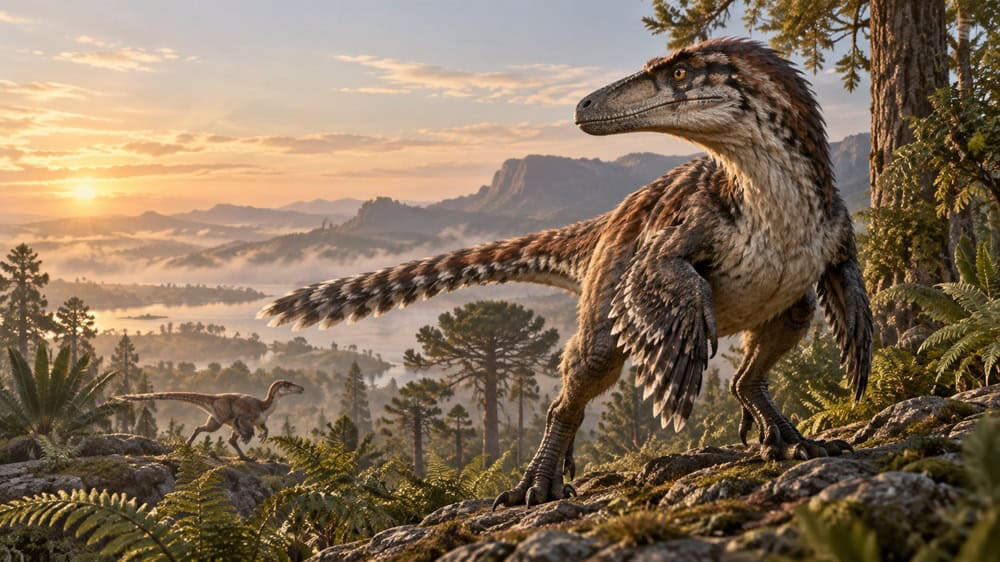
The Utahraptor couldn’t compete with these giants on its own, but scientists believe it hunted in packs. A coordinated group of these raptors — each armed with a 24-centimetre sickle claw — could bring down prey far larger than themselves, turning collective intelligence into the deadliest weapon of the Early Cretaceous.
Did being the strongest mean being the biggest or the fastest?
Strength in the dinosaur world didn’t depend solely on size. The Carnotaurus, for instance, was neither the largest carnivore nor the one with the strongest bite, yet it’s estimated to have reached speeds of around 50 km/h, making it one of the fastest theropods of its era. Its speed more than made up for its smaller size compared to rivals like the T. rex, allowing it to chase down prey that other predators couldn’t even pursue.
The Allosaurus, the dominant predator of the Late Jurassic, used a completely different strategy. It opened its jaws like a hatchet and struck its prey from above, using the weight of its skull as a blunt weapon. It didn’t need the bone-crushing bite of the T. rex because its hunting technique was optimised to wound and weaken rather than to pulverise.
These examples show that evolution didn’t reward just one type of strength — it favoured the most efficient adaptation to each environment and available prey. The true power of these animals lay in how each species developed unique tools for survival within its own ecosystem. If you’d like to learn more about these predators’ feeding strategies, we recommend our article on what dinosaurs ate, where we explore the diets of carnivores, herbivores and omnivores in detail.
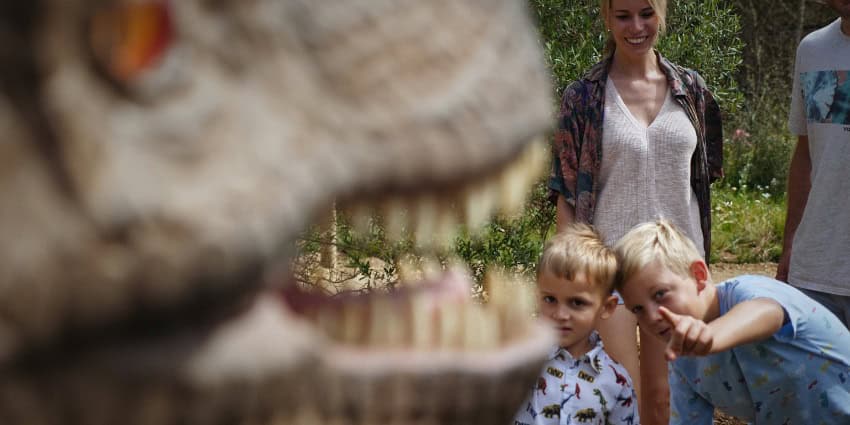
If you want to see these prehistoric titans up close and decide for yourself which was the strongest, visit Dinosaurland in Porto Cristo, Mallorca. Walk among life-sized replicas of the T. rex, Spinosaurus, Ankylosaurus and many more, and discover what it feels like to stand face to face with the most powerful dinosaurs that ever lived.
Frequently asked questions about the strongest dinosaur
Which is the strongest dinosaur of all time?
The Tyrannosaurus rex is considered the strongest dinosaur in terms of bite force, with an estimated jaw pressure of between 35,000 and 57,000 newtons — the highest ever recorded in a land animal. However, if we look at strength as a broader concept that includes defence, charging power and overall size, other dinosaurs such as the Ankylosaurus, Triceratops and Spinosaurus also make a serious case for the title. The answer depends on which type of strength we value most: bite, size, defence or speed.
Was the Spinosaurus stronger than the T. rex?
The Spinosaurus was bigger than the T. rex, measuring between 15 and 16 metres compared to the tyrannosaur’s 12, and weighing roughly 10 tonnes. However, the T. rex had a far more powerful bite and a sturdier skull. In a hypothetical land-based confrontation, most palaeontologists believe the T. rex would have had the upper hand thanks to its bone-crushing bite and more compact, muscular build, whereas in water the Spinosaurus would have clearly dominated thanks to its semi-aquatic adaptations.
Which herbivorous dinosaur could defeat a carnivore?
The Ankylosaurus and the Triceratops were herbivores capable of successfully taking on the largest predators of their time. The Ankylosaurus could shatter bones with its club-shaped tail — a devastating defensive weapon. The Triceratops wielded its three horns as deadly lances against any attacker. Fossils of T. rex bearing Triceratops horn marks have been found, scientifically confirming that these herbivores stood their ground against the most feared predators of the Cretaceous.
Can you see the strongest dinosaurs at Dinosaurland in Mallorca?
At Dinosaurland in Porto Cristo, Mallorca, you can see life-sized replicas of history’s strongest dinosaurs, including the Tyrannosaurus rex, Spinosaurus, Ankylosaurus, Triceratops, Utahraptor and many more. The park features over 100 replicas spread along a route that takes approximately 2 to 3 hours, where you’ll learn about their weapons, defences and behaviours. It’s an ideal experience for families and palaeontology enthusiasts looking to discover the power of these prehistoric giants.